Why Only This Deck Graced the Tables of *American Gods*' Death God's Casino?
"Gods are great, but man is greater. For it was man who created the gods."
— Neil Gaiman, American Gods
In Neil Gaiman’s metaphor-rich universe, the Old Gods never truly died. They shed their dusty robes for modern suits, masquerading as funeral home directors, taxi drivers, or hidden within neon-lit casinos, struggling to survive in the crevices of contemporary society.
"What kind of playing cards would an ancient Egyptian God of Death, mingling in a modern casino, place on the table?"
This wasn't just a challenge for the art department of the American Gods series; it was also the ultimate question designer Steve Minty sought to answer when creating Anubis & Osiris.
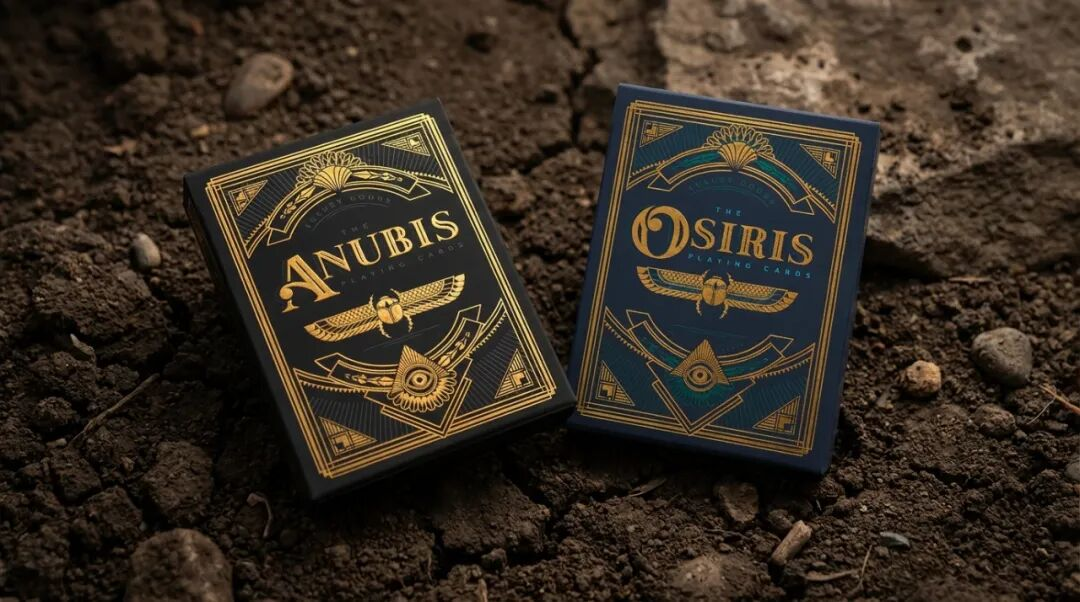
Ordinary Bicycle Bee decks felt too mundane, incapable of bearing the weight of life and death. Vintage, traditional Egyptian-style cards were too anachronistic, struggling to blend with the flickering lights of a modern casino.
They urgently needed a "perfect disguise": a deck that appeared modern, with contemporary blood flowing through its veins, yet inherently remained a sacred artifact of the majestic deities from the banks of the Nile.
Thus, Anubis was chosen. Under the dim lights of the series' first season, fourth episode, as protagonist Laura Moon expertly shuffled and dealt, the camera swept over the deep black card backs and flowing gold lines. In that moment, the deck seemed to have been born from that mythical world itself.
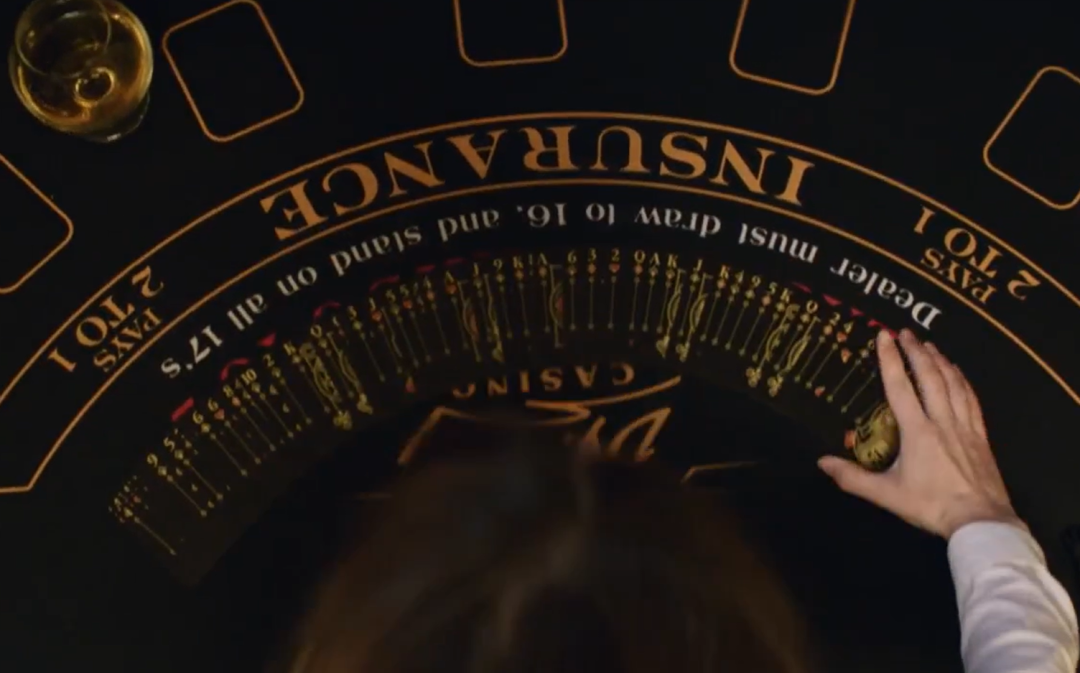
This dimension-breaking moment created an unexpected effect: countless fans of the show and non-card players began searching for this "Anubis-like" deck. Such cross-disciplinary attention caused the deck’s value on the secondary market to skyrocket overnight, from an accessible crowdfunding price of a dozen dollars to one hundred, even two hundred dollars a set. It transformed from an excellent design within the collecting community into a genuine mythical prop.
When the Nile Meets Art Deco
Steve Minty didn't act as an archaeologist; he was more like a master tailor. He understood that for these ancient deities to return to the human realm, it wasn't enough to simply replicate the aged patina of excavated artifacts; they also needed the elegance of someone who had just stepped out of a Gatsby party.
He acutely captured a specific historical period: the Egyptian Revival.
It was the 1920s, and with the discovery of Tutankhamun's tomb, the Western world developed an almost frantic fascination with Egyptian aesthetics. Anubis & Osiris is a modern heir to this aesthetic, integrating the industrial lines of Art Deco.
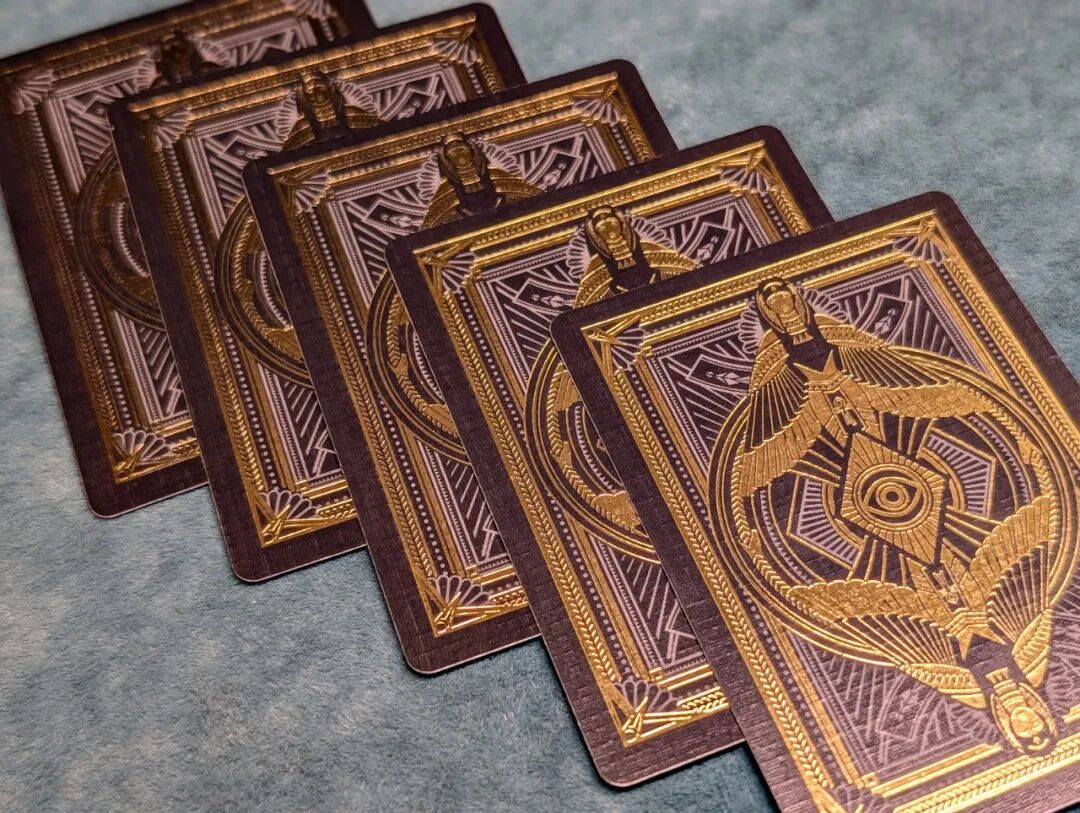
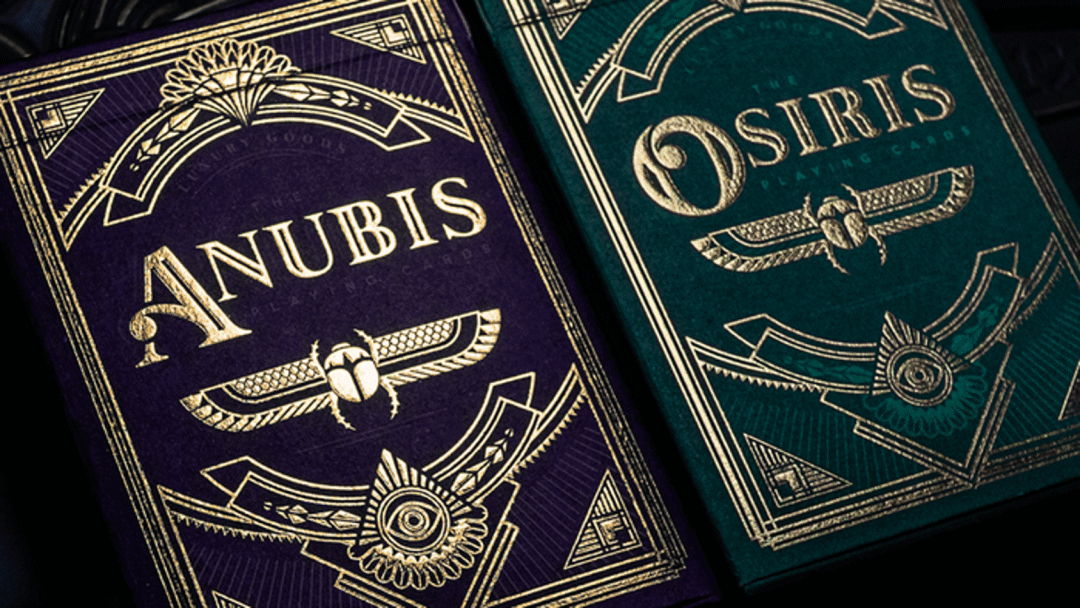
In the back design, Minty discarded the natural, organic feather depictions found in ancient Egyptian frescoes, instead rendering the scarab beetle's wings as crisp metallic cuts and radial geometric forms.
These lines closely resemble the metal grilles of early 20th-century skyscrapers. Under this aesthetic, Anubis shed his identity as a sinister tomb guardian, transforming into a cool-eyed modern gentleman in black and gold evening wear. This deck, then, became the Old Gods' most perfect disguise for this era.
The Life-and-Death Juxtaposition of Two Goddesses
The face card designs of both decks are largely identical, with the primary distinctions residing in the card backs and the Ace of Spades.
Designer Minty has embedded here an ultimate juxtaposition concerning life and death. He didn't directly print the main protagonists of the deck (Anubis and Osiris) on the card backs or feature cards, but instead chose two goddesses who were crucially important to them.
Isis – The Resurrective Power of a Wife
In the Osiris deck, Isis is chosen as the goddess for both the card back and the Ace of Spades, occupying the visual core.
She wears her iconic cow-horn sun disk, with another cow-horn sun disk in the background forming the silhouette of the Spade pip. This is an uplifting, vibrant pose.
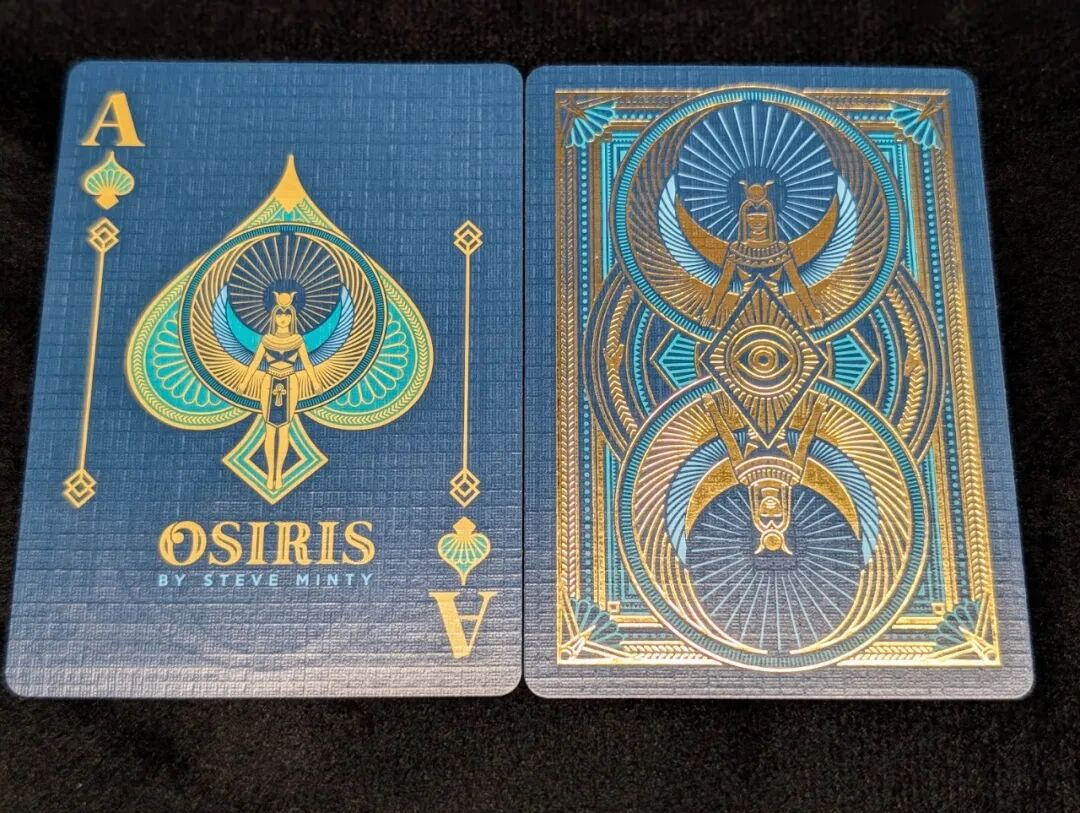
In myth, while Osiris is the Lord of the Underworld, he is passively the deceased. It was his wife Isis who traversed the lands of Egypt to retrieve his dismembered body parts, magically reassembling and resurrecting him.
Without Isis, Osiris would merely be a broken corpse. In this blue deck, representing "life and resurrection," Isis is the driving force. Her upward-sweeping wings uphold the entire deck's theme of "rebirth."
Nephthys – The Silent Guardianship of a Mother
Conversely, in the Anubis edition, the protagonist of the card back and the Ace of Spades is a different goddess.
Her wings are instead depicted as drooping downwards, forming the edges of the Spade. This is Isis's sister—Nephthys. She doesn't wear the common house-shaped headdress, but a vulture headdress symbolizing motherhood and protection.
Nephthys is not only the protector of the dead but also Anubis's birth mother. If Isis represents "the hope of life," then Nephthys embodies "the tranquility of death."
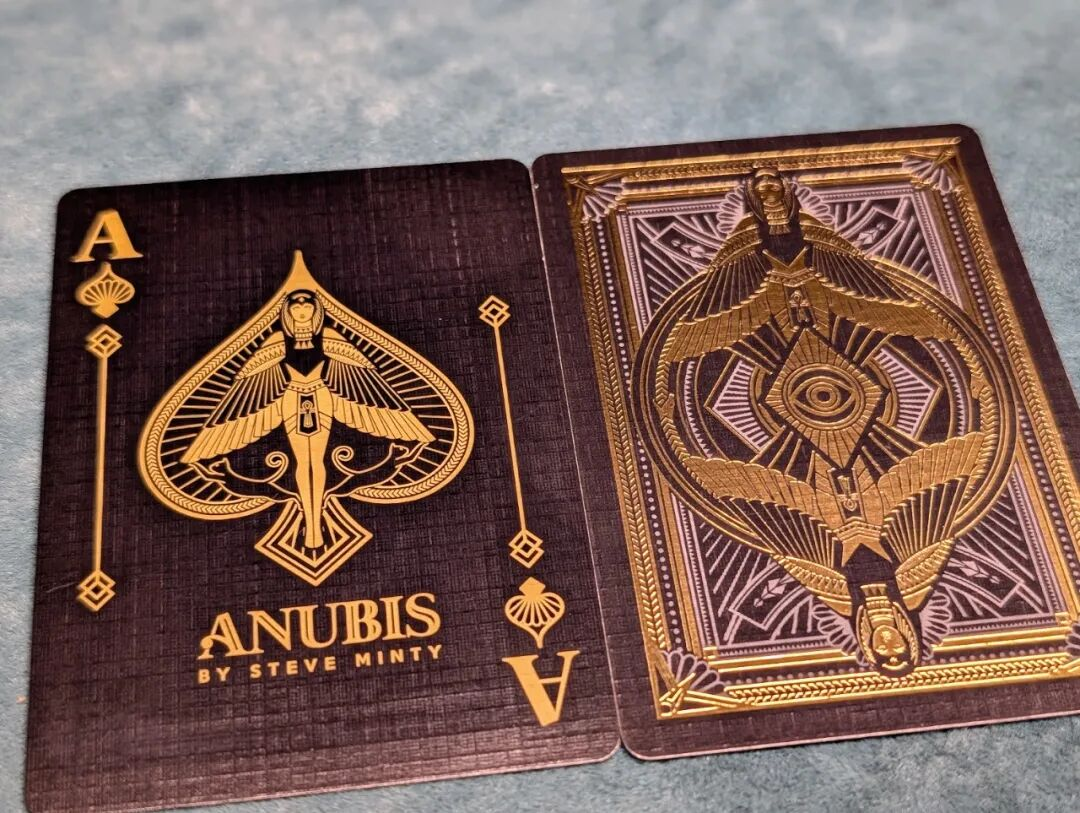
In this black deck, representing "the underworld and death," Mother Nephthys appears with a more restrained, serene demeanor. Her downward-sweeping wings offer a gentle shelter for the departed.
Underworld Deities Tamed by Geometry
Turning to the other face cards, we witness a visual experiment in the systematization of divinity. The designer has boldly reconstructed the ancient gods using a modern illustrative language.
From Wild Jackal to Underworld Gentleman
On the King of Clubs, we see the evolution of Anubis. In primitive mythology, he often appears as a black jackal roaming cemeteries, or a wild, untamed jackal-headed man. But under Minty's brush, this deity is imbued with an unprecedented sense of civilization. The designer eschewed realistic muscular depictions, instead using highly abstracted geometric lines to construct the body. His traditional broad collar is simplified into precise triangular patterns.
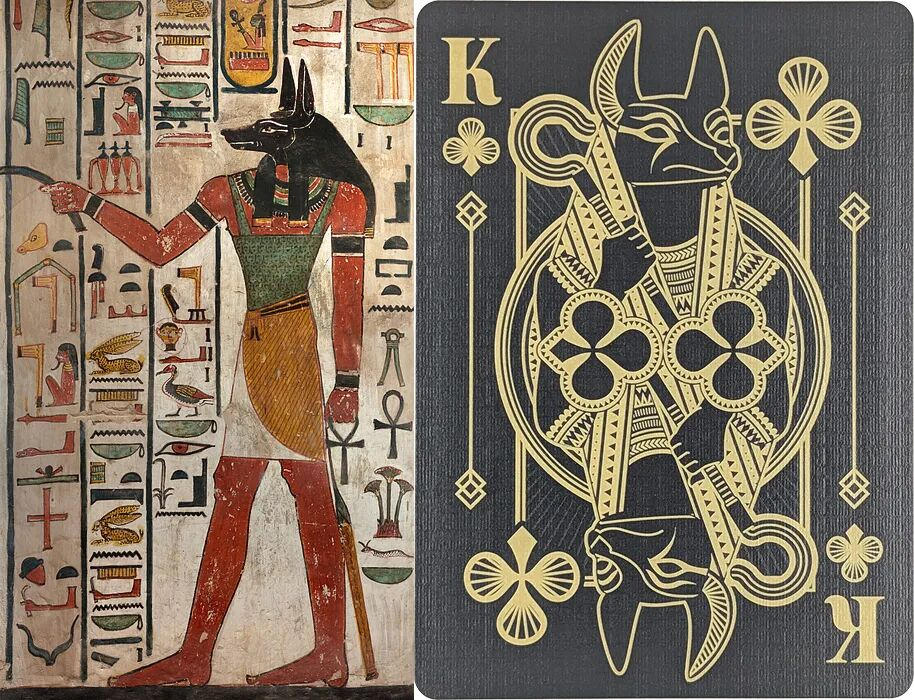
Even his stance, holding the crook and flail, is rendered flat and symmetrical. This restrained style diminishes his wildness, imbuing him with calmness and rationality—no longer the God of Death roaming the wilderness, but rather a solemn administrator maintaining order in the casino.
From Mummified Corpse to King of Resurrection
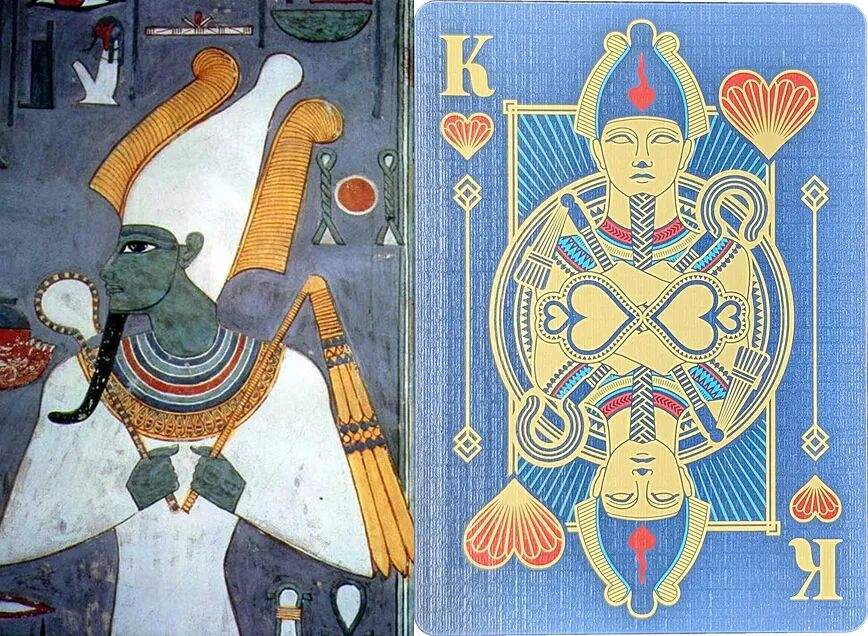
The King of Hearts belongs to Osiris. In ancient Egyptian frescoes, Osiris is typically depicted as a mummy tightly bound in white shrouds, with a greenish complexion, stiff and lifeless. Yet, in this deck, Minty allows him to break free from the rigidity of death. While retaining his classic crossed-arm posture, flowing lines and rich costume details imbue him with the dynamism of a king. He is no longer the fragmented corpse but a monarch who has just completed the resurrection ritual, reasserting his dominion over the underworld.
From Mythical Creature to Symbolic Seal
For the Joker cards, Minty introduces more enigmatic guardian symbols. At the center is a winged scarab beetle, symbolizing rebirth and the rising sun; on either side, two Egyptian cat deities (Bastet) sit back-to-back. Here, as guardians of home and secrets, they vigilantly watch over the boundaries of life and death.
This symmetrical composition completely symbolises these mythical creatures, transforming them into solemn insignias, akin to the supporters found in a noble coat of arms.
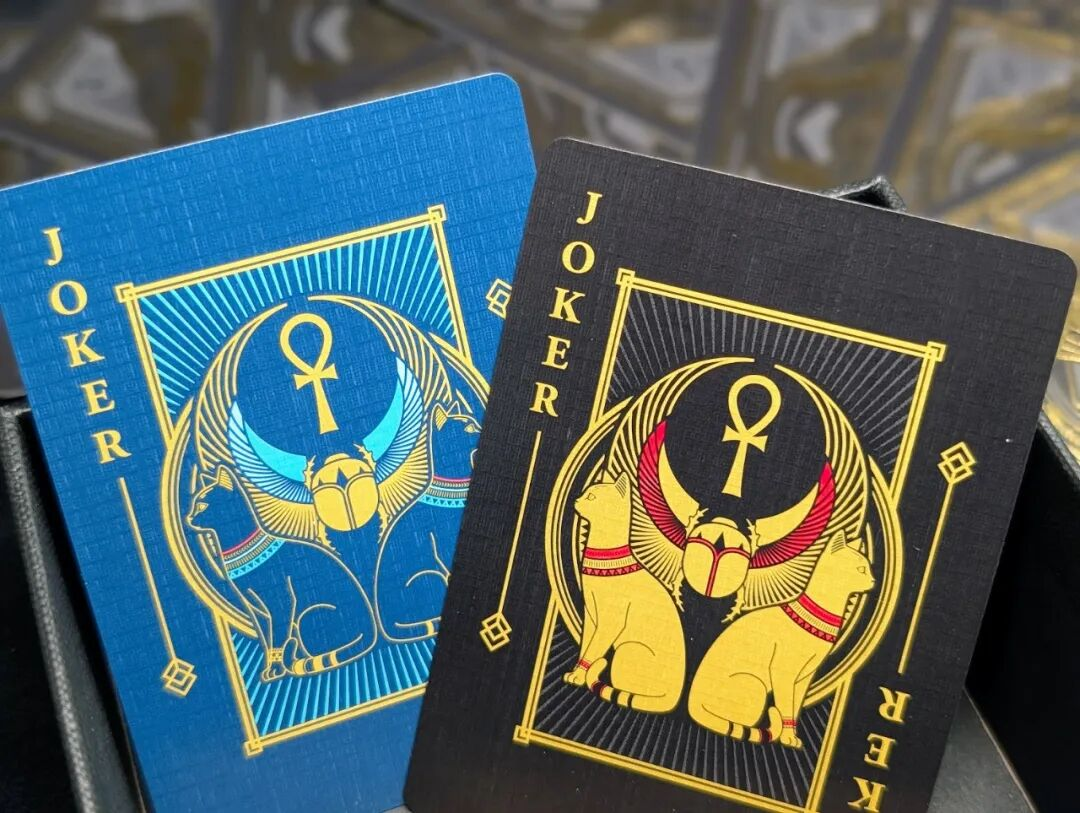
The designer foregoes simple portraiture, instead conveying the concept of "God is Symbol." This abstract design language is both the essence of modern graphic design and the wisdom of the Old Gods' survival in contemporary society.
The Imprint of Force and Faience Blue
For a premium deck of playing cards, touch and sight are equally paramount.
The Imprint of Hot Foil Stamping
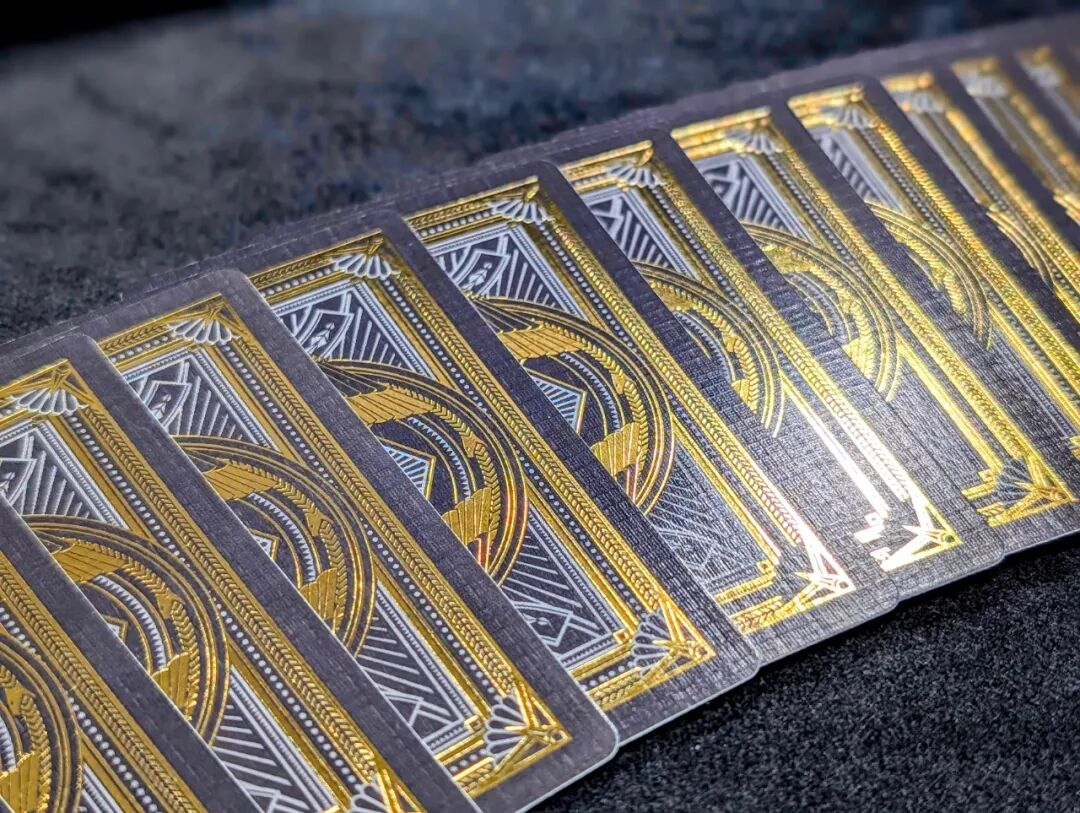
This deck's most captivating physical attribute lies within its card backs. Printed by EPCC, it employs a hot foil stamping process, a technique less common today.
Unlike the widely adopted cold foil technology, hot foil stamping applies physical pressure during impression, stamping the gold foil directly into the paper fibers. When you run your finger over the card back, your fingertips detect a distinct, tangible debossment.
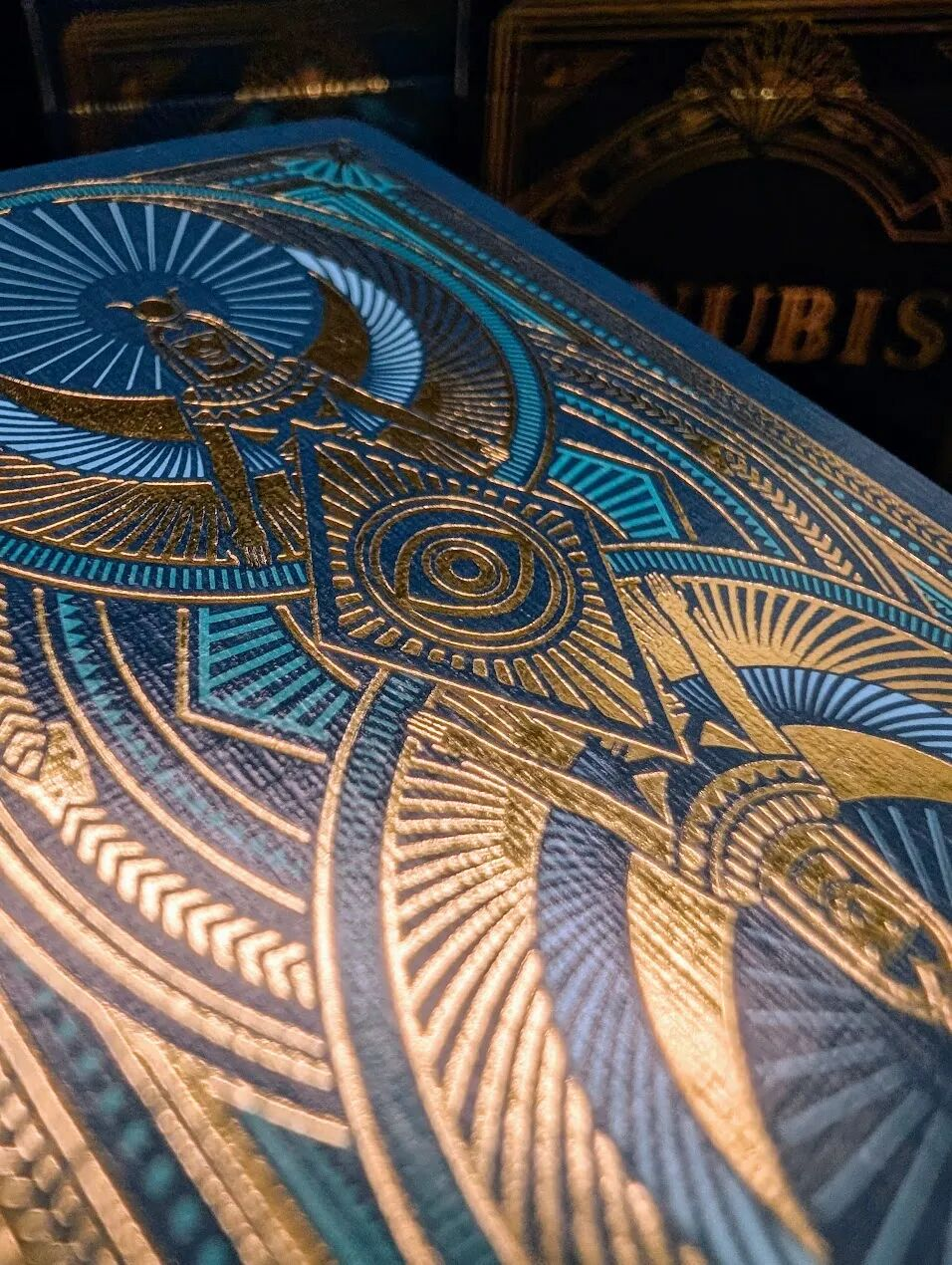
This pressure even penetrates the card stock's core—viewing the face side (front) under specific lighting, you can still faintly discern the impressions left by the hot foil pattern on the back.
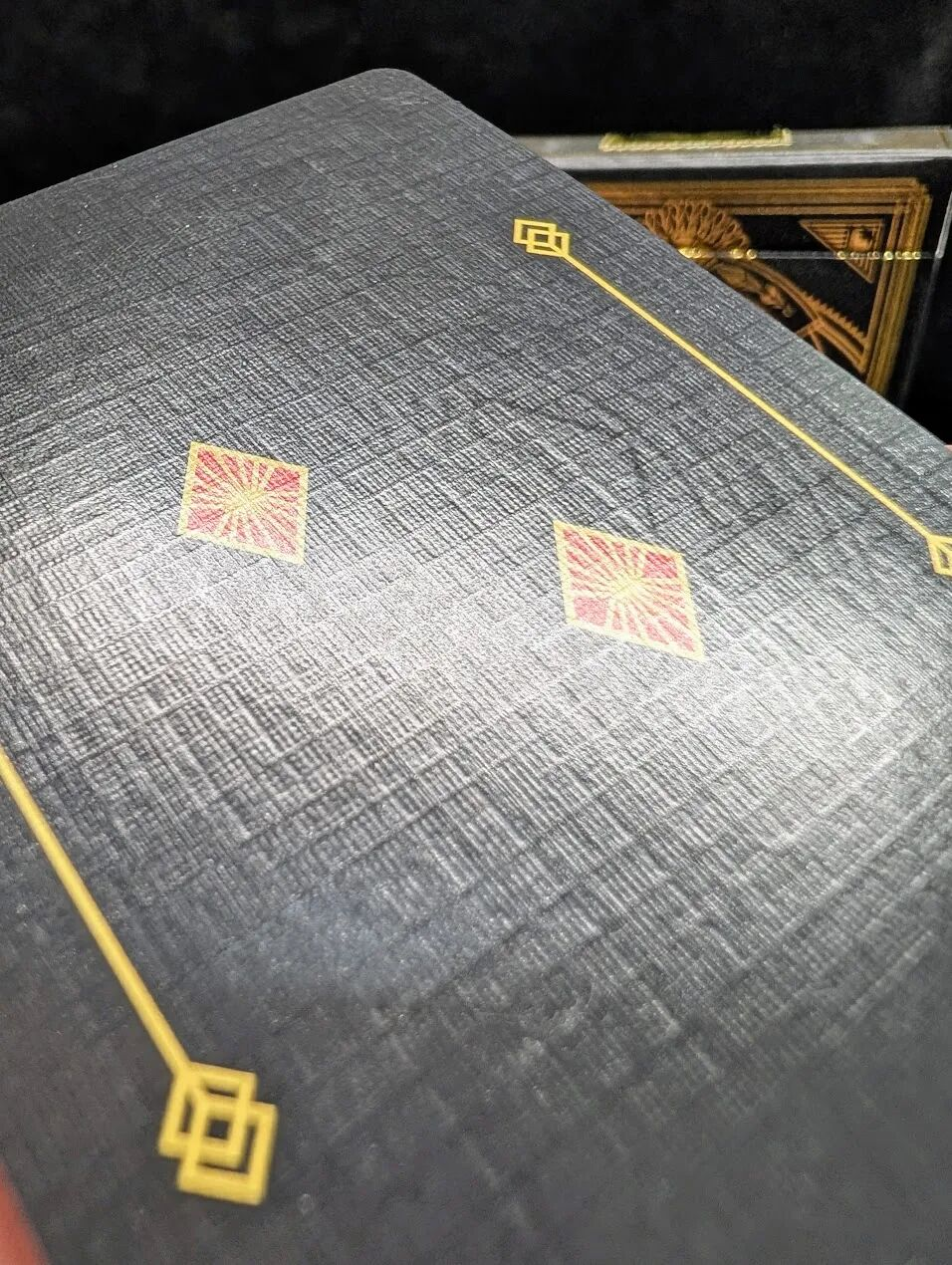
This tactile embossment gives the cards a substantial, tangible weight. It is not a flimsy piece of paper, but rather like a miniature slate inscribed with incantations, solemn and inviolable.
Black Land and Faience Ceramics
Beneath the same artisanal framework, the Anubis and Osiris editions construct distinctly different spiritual worlds through their colors.
The Anubis edition opts for a profound matte black, symbolizing Kemet (ancient Egyptian for "black land")—the fertile silt left by the Nile's annual inundation, a cradle of death and rebirth.
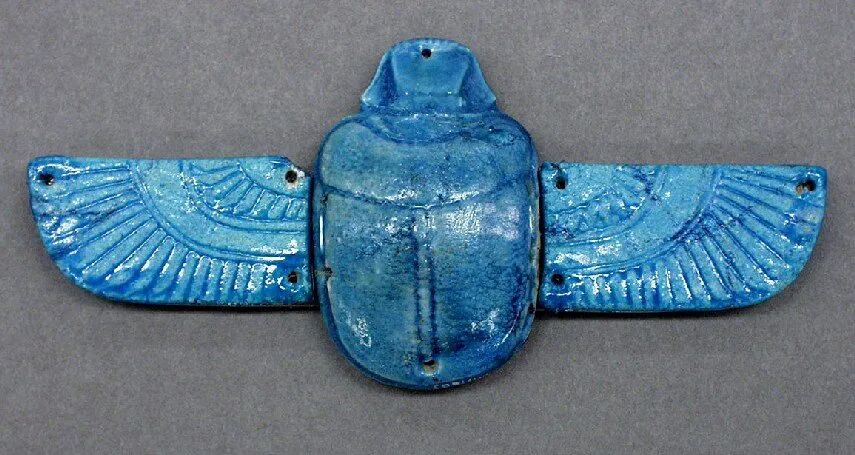
The Osiris edition, conversely, presents a deep Egyptian blue. Beyond a simple blue, the designer ingeniously incorporates hints of blue-green. This interplay of blue and green precisely reproduces the texture of ancient Egypt's most prized Faience ceramics. This material was known in ancient Egypt as "tjehenet," meaning "shining thing," symbolizing immortal vitality.
The Echo of the Phantom
Years later, Steve Minty released a V2 edition of this deck, naming it the Shadow Edition. This seems a curious intertextual nod—after all, American Gods' protagonist is indeed Shadow Moon.
Although the V2's fulfillment ran into considerable difficulties, making this indirect homage less than perfect, from Anubis to Shadow, from the ancient gods on the banks of the Nile to props on a modern screen, this deck completes a fascinating cultural loop.
As a vessel imbued with mythology, design, and pop culture, when you take out this black Anubis deck late at night, feeling the gold foil impressions beneath your fingertips and gazing at those ancient deities draped in Art Deco lines, you understand:
No matter how times change, the Old Gods will always find new visages. Under the neon lights of the modern card table, they are still present.
DIGITAL EXHIBITION HALL
Enter the Digital Exhibition Hall for a high-definition, 3D interactive, immersive experience.