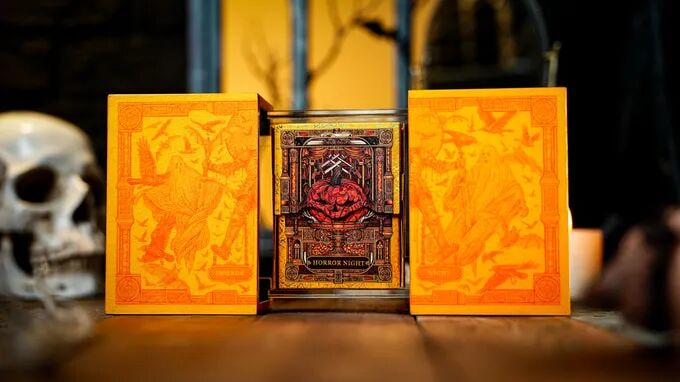
ARK's Horror Night: A Mechanized Altar to Awaken
The clock had just struck midnight.
The wind outside sounds like the whispers of some unseen creature. You extinguish all the lights in the room, leaving only a single candle burning, its flame casting flickering, uneasy shadows across the tabletop.
Before you lies the fabled "mechanism box."
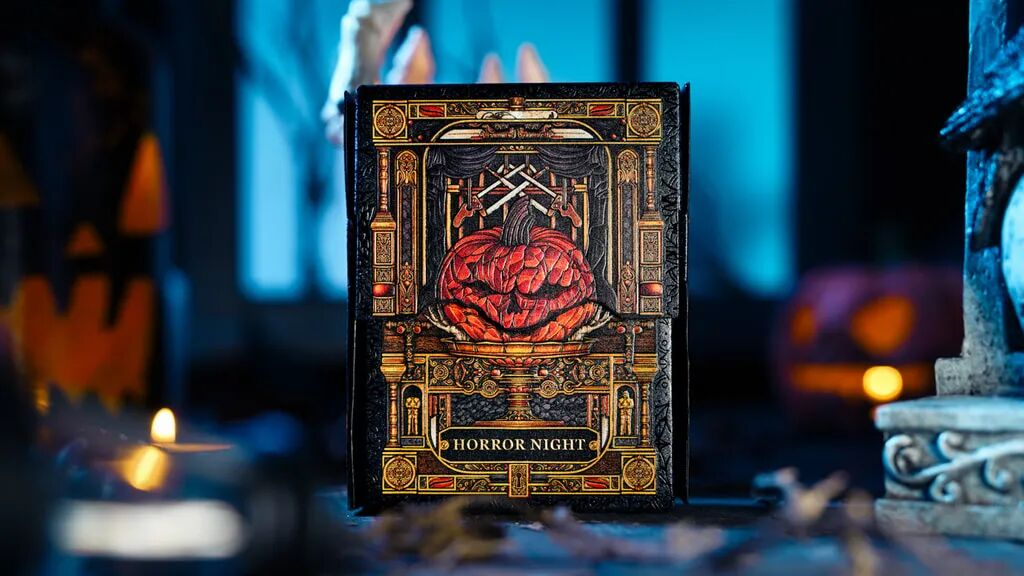
It is cold, heavy, and utterly black, like a miniature sarcophagus or an ancient altar. The pumpkin relief at its center seems to smile unsettlingly in the candlelight. It doesn't feel like a gift waiting to be "opened," but rather a forbidden artifact waiting to be "awakened." You're not even sure if you should begin this ritual.
This, then, is ARK's most alluring challenge to all collectors this Halloween: Horror Night.
Every time I encounter a new ARK project, my feelings are undeniably complex.
On one hand, one cannot help but admire their audacity. In a collecting sphere often dominated by mere "recolors," ARK consistently charges headfirst down the narrow path of intricate "structural engineering" and "heavy-duty material stacking." Yet, on the other hand, both my wallet and my modest display shelves invariably tremble—the former due to the price, the latter due to the sheer volume these artistic creations demand for proper exhibition.
Halloween themes are hardly novel within the playing card community; pumpkins, haunted houses, and skulls are elements we've seen countless times. So, when ARK unveiled their latest creation, Horror Night, my immediate question was: What new trick could they possibly pull off?
The answer: They weren't content to merely "illustrate" Halloween; they intended to "construct" it. The result is a paper altar that demands unlocking, a Gothic world presenting "Twelve Prisoners," and an ambitious multi-layered narrative.
Feature One: A Paper Mechanism Not Just for Viewing, But for Unlocking
This time, ARK appears to have doubled down on their forte: "structural engineering."
Undoubtedly, the deck's central highlight is its tuck box. ARK has once again deployed their signature "ARK Case" double-layer tuck box structure, but this iteration, judging by the promotional images, showcases even greater ingenuity than any of their previous works.
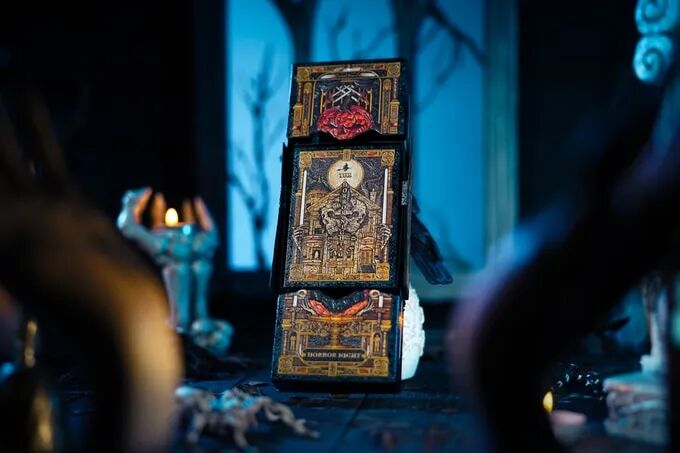
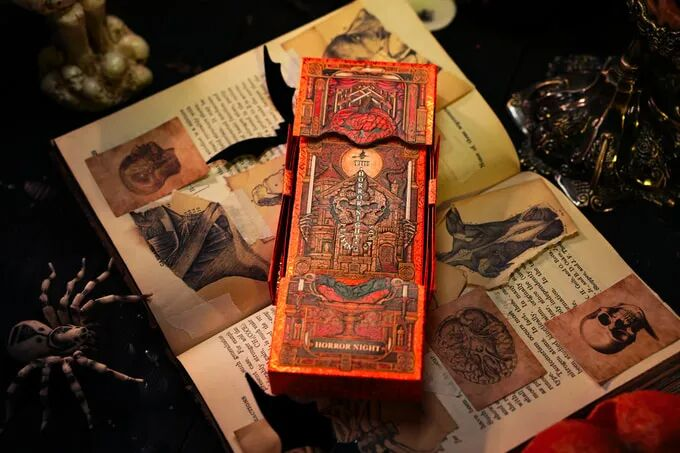
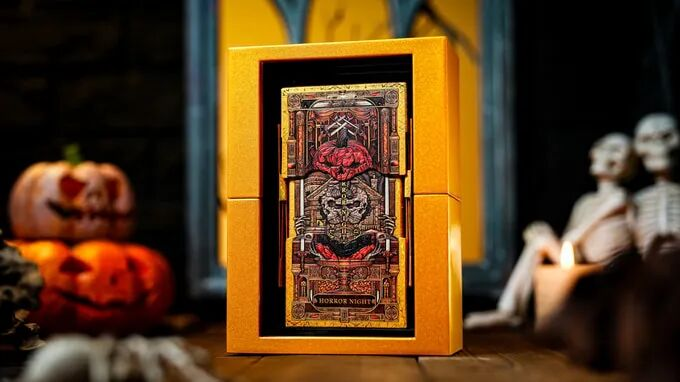
The outer tuck box forms an altar centered around a Halloween jack-o'-lantern. The true secret, however, resides within the inner layer—a sophisticated, vertically integrated sliding mechanism.
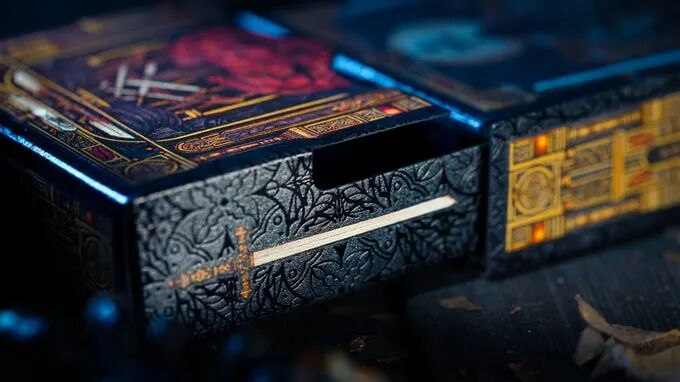
When you grasp the lower half of the inner box and pull down, its upper portion automatically actuates with the mechanism. This action perfectly mimics a jack-o'-lantern "opening its mouth," revealing a terrifying mansion composed of three-headed demons and skeletons hidden behind it.
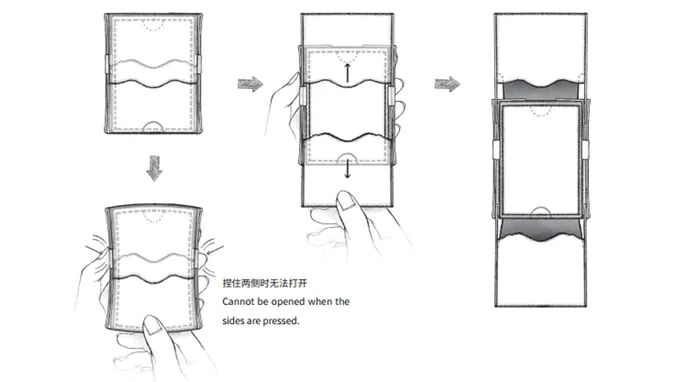
Even more intriguing, this sliding mechanism incorporates a special locking feature. Structural diagrams reveal that if you hold the tuck box by its sides in a conventional manner, the mechanism remains locked. This adds an element of puzzle-solving and exclusive ritualism; in the official parlance, it's no longer a mere tuck box, but a forbidden artifact that demands awakening.
Naturally, such an intricate paper mechanism always elicits a touch of apprehension. Its durability is inherently limited, positioning it more as a collector's "puzzle box" than a magician's or flourish artist's everyday tool. Its design intent, perhaps, is not for frequent opening and closing, but rather for a single, solemn "unlocking" on a specific night of terror.
Notably, the standard edition tuck box deviates from ARK's usual penchant for muted yellows and vintage color palettes. Instead, it adopts a deeper, more textured black as its base color—an undeniably thematic choice.
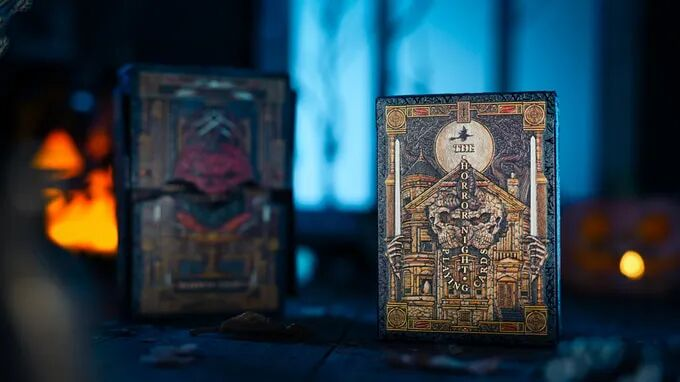
Feature Two: A Gothic Altar Offering the 'Twelve Prisoners'
Upon activating the mechanism, the altar's "offerings" are revealed in their entirety.
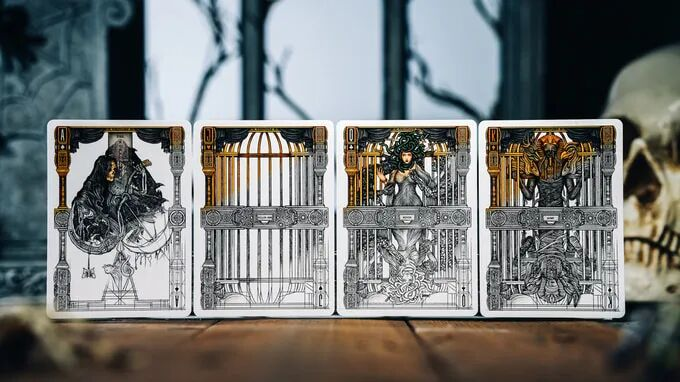
Regarding the offerings, the twelve court cards serve as a veritable "who's who of classic Western horror." From Universal Pictures' iconic monsters like Dracula, the Werewolf, the Mummy, and Frankenstein's Monster, to mythological figures such as Medusa, Sirens, and the Minotaur, and even folkloric witches and modern symbols of terror like zombies. This selection of "prisoners" both pays homage to silver-screen classics and delves into ancient legends.
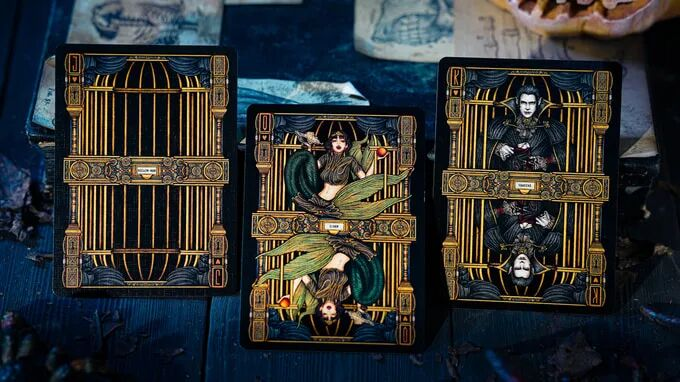
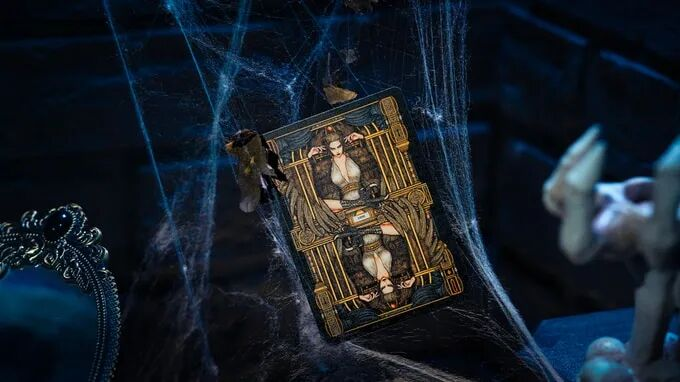
The true stroke of genius in the design lies within the opulent Gothic "cage." This cage is not merely a simple framework; its symbolism is profoundly rich:
- Unity: It functions as a powerful visual 'anchor,' forcibly unifying twelve monsters of wildly disparate styles, origins, and forms under a singular 'Neo-Gothic' aesthetic.
- Narrative: It hints at a backstory of 'sacrifice' or 'imprisonment.' These powerful beings are not free but rather captured and displayed as 'offerings.' This precisely conveys a cursed fate and the official warning: 'Observe from a distance; do not desecrate.'
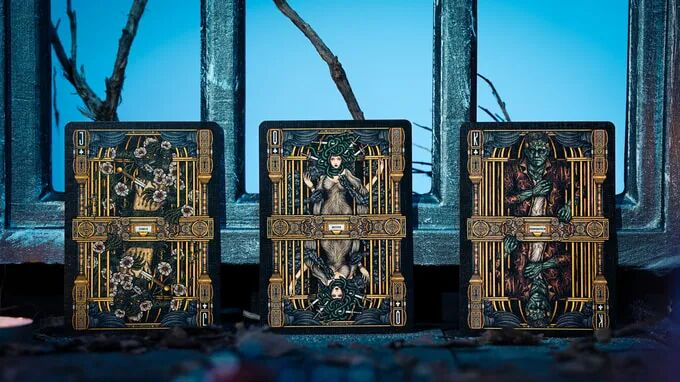
The color palette of the standard edition is also remarkably restrained. The card faces feature expansive deep black backgrounds, while the cage itself boasts a shimmering, metallic bronze hue. The monsters themselves are rendered with selective, realistic coloration. This high-contrast scheme makes the monstrous subjects 'leap out' from the darkness, while the golden cage acts as an ornate frame, firmly 'pinning' them before the viewer's eyes, imbuing the artwork with immense dramatic tension.
If the court cards are the 'imprisoned offerings' presented to the altar, then the card back is the altar's tabletop itself.
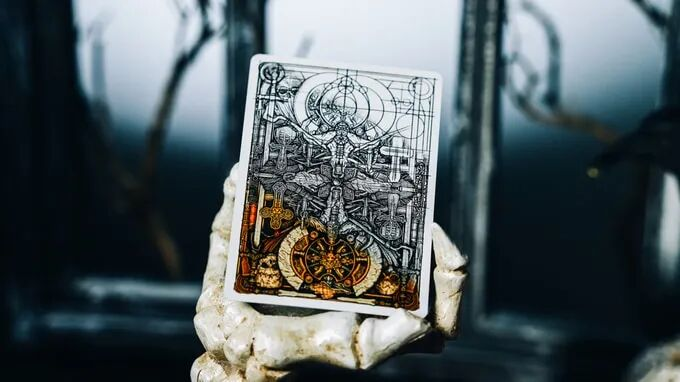
It functions as an elaborately arranged 'trophy display,' appearing at first glance as intricate clutter, but upon closer inspection, it reveals a rich narrative interplay. Here, one finds not only the relics of monsters but also the weaponry used in their hunt.
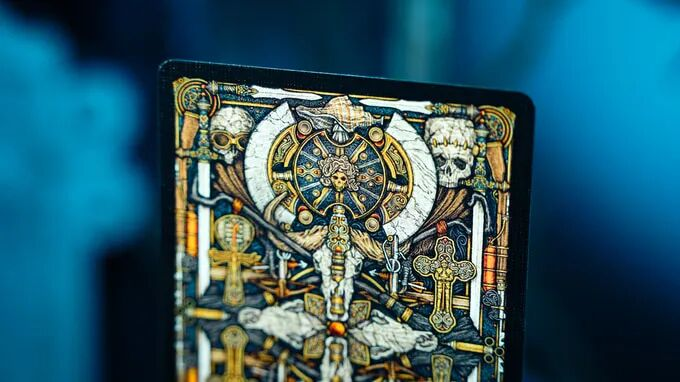
Consider the details:
- Central Trophies: At the heart of the card back lies the Minotaur's skull, its colossal axe forming the composition's foundation. Embedded within the axe blade's wheel-like center is the severed, snake-haired head of Medusa.
- Narrative Interplay: The elements are far from isolated. Two witch's brooms traverse the design, their ends deftly hooked around nearby longswords. A Harpy's severed claw grips a crossbow bolt.
- Arms and Totems: Ancient Egyptian 'Ankh' symbols and Runic crosses are displayed as totems, alongside scattered weapons like longswords and matchlock guns. The goggled skull in the upper left and the stitched skull in the upper right represent the ultimate demise of 'Frankenstein's Monster' and 'Zombies,' respectively.
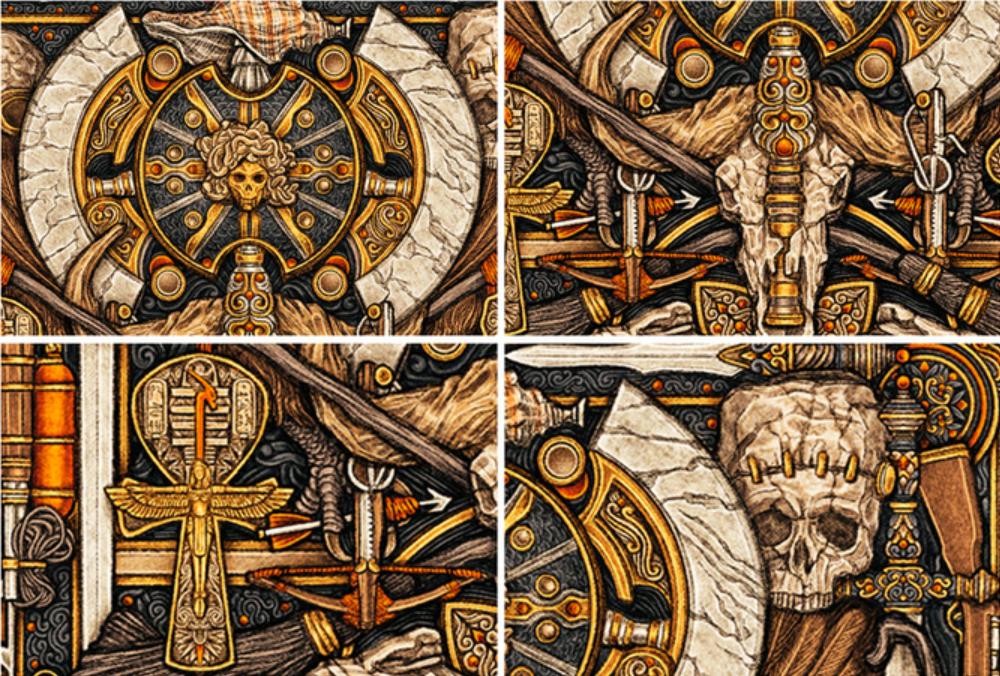
This card back is a frozen narrative moment, a manifest of 'hunting spoils' that re-enshrines the court card prisoners as 'trophies' upon the altar.
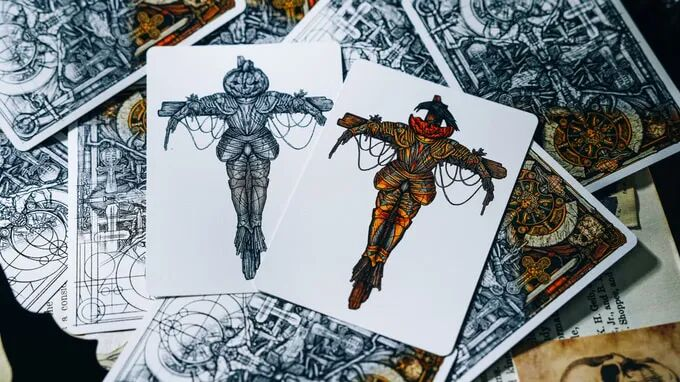
The two Jokers, meanwhile, depict scarecrows clad in knightly armor and pumpkin heads, a fusion of absurdity and valor that echoes the origins of Halloween.
Feature Three: The Ambition to Evolve from 'Visual Opulence' to 'Experiential Design'
Having explored the mechanism and art style, let's now discuss ARK's advancement this time—a shift from mere visual opulence to comprehensive experiential design.
(1) Tactile Evolution of the HOLO Edition
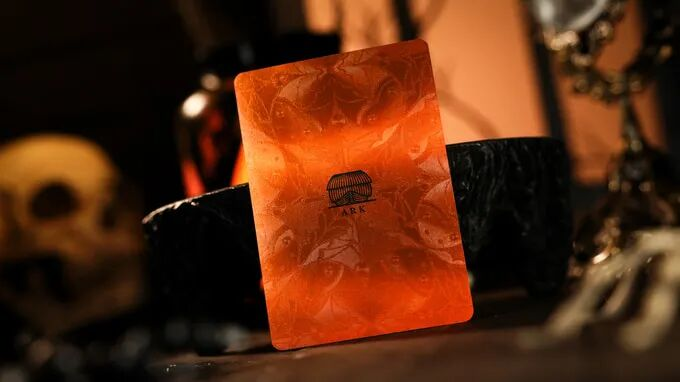
The HOLO foiled edition cards within the gift set feature dazzling warm-orange holographic hot foil stamping. At the core of their craftsmanship is a unique surface treatment ARK has dubbed 'Mystery Finish.' Upon closer inspection, you'll observe that the card surfaces (especially in the HOLO areas) are overlaid with an incredibly fine, spiderweb-like texture. This embossing serves two purposes: firstly, it visually enhances the atmosphere of lurking horror and the unknown; secondly, functionally, it very likely improves the handling characteristics of full-bleed HOLO foiled cards, thereby elevating their manipulability.
(2) Narrative Evolution of the Sketch Edition
Previously, the monochromatic decks included in ARK's gift sets were often criticized by enthusiasts as mere bundle fillers. After all, the HOLO edition in an artist's gift set typically offered the best value—boasting thematic colors, premium craftsmanship, and the ARK Case experience—making the monochromatic version feel somewhat superfluous.
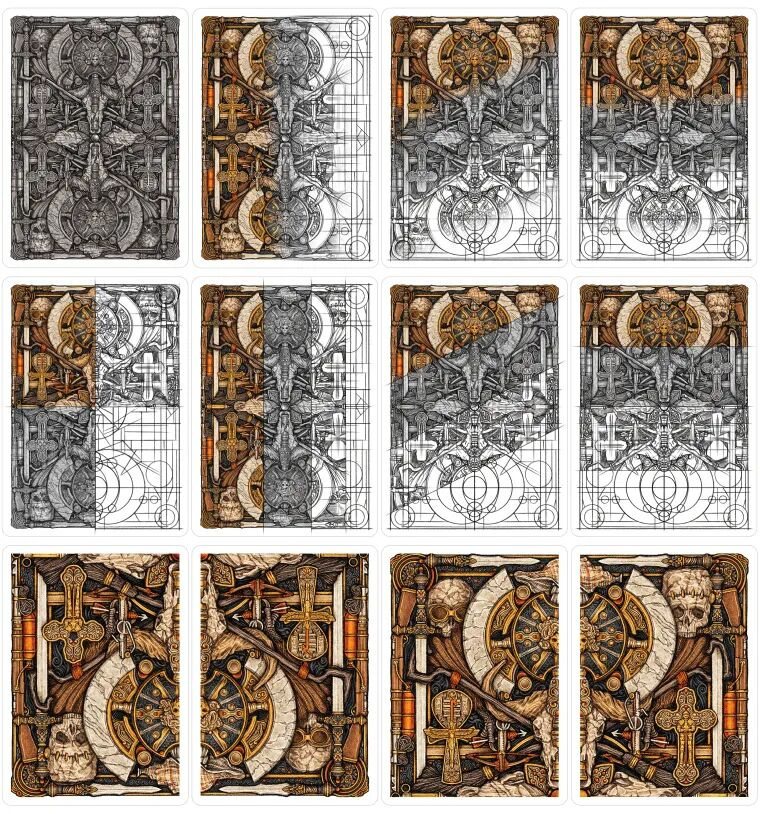
Following this feedback, the team decided to empower this deck to truly fulfill the narrative function expected of an artist's gift set: 'to disclose the design journey and intricate details.'
To achieve this, the team explored numerous approaches (as shown above), including designs with dividing lines, four-panel collages, enlarged card back details (third row in the image above), and even one concept that directly featured a photograph of the designer in the act of drawing. Ultimately, the team settled on the concept dubbed 'Dipped in Paint.'
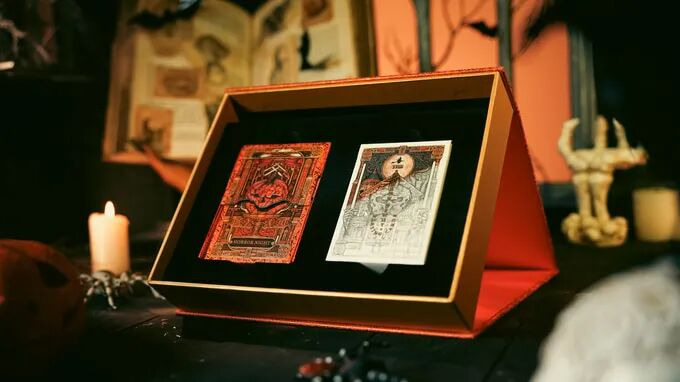
The final product is no longer a mere single line art deck; instead, it ingeniously integrates four critical stages of the creative process—'structural sketch,' 'initial line art,' 'refined manuscript,' and 'final colored render'—into a single deck through gradients and diagonal divisions. This design allows collectors to intuitively experience the evolution of an illustration from initial inspiration to finished product, transforming it from a mere extra into a true journey of creation.
(3) The Wooden Box Edition: The Ultimate 'Display Altar'
Limited to 333 sets, the Wooden Box Edition is tailor-made for 'display connoisseurs,' itself serving as the ultimate 'altar.' ARK has, for the first time, integrated a high-transparency acrylic inner case within the wooden box.
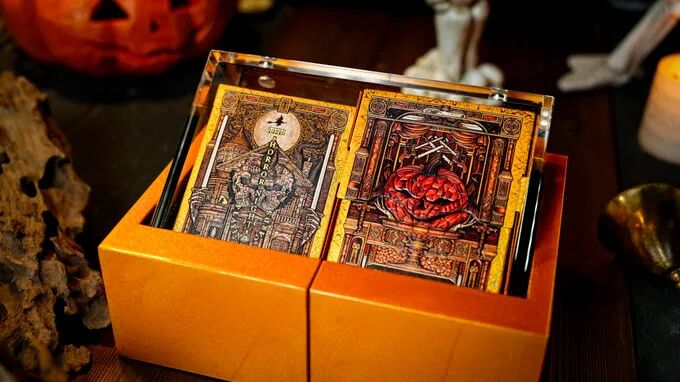
With the integrated hooks on the acrylic inner case, you can perfectly secure the opened tuck box, allowing for a vertical display of the complete mechanism with the pumpkin 'mouth agape.' This elegantly solves the ARK Case's most significant display challenge: how to exhibit its complex form once opened.
However, the most contentious aspect of this wooden box may lie in its material choice. Lacquer finishes are typically applied to MDF (Medium-Density Fibreboard) to ensure flatness and low shrinkage, preventing the lacquer from cracking. Yet, on the surface, this sounds like a downgrade in prestige, moving from black walnut to particle board.
In reality, however, a multi-layered, polished piano lacquer finish—a process of immense complexity with a high scrap rate—often incurs a final cost surpassing that of a conventional solid black walnut box. This isn't a cost-reduction measure, but rather a choice for an entirely different path to 'luxury'—a more modern, colder, and industrial 'altar' aesthetic.
Furthermore, ARK has, for the first time, incorporated illustrative elements onto the lacquered wooden box. According to Lenko, this is achieved by integrating printed paper with the wooden box, allowing it to retain the unique tactile and visual texture of paper.