The Persian Simurgh's Triumph Over AI: Unpacking Shahnameh, DOTY 2025's Grand Slam Winner, from Flawless Back to Perfect Imperfections
Stories often begin in desperation.
Legend has it that in ancient Persia, an infant, born with a full head of white hair, was deemed inauspicious and abandoned by his father on the snow-capped Elburz mountains. As he lay near death, a Simurgh, a mythical bird symbolizing wisdom and healing, descended from the heavens, carried him to its nest, and raised him.
Years later, when the young man had to return to the human world, the Simurgh gifted him a feather, telling him: when you are in despair, light it, and I will come.
Over a thousand years later, Shabnam Adiban, an Iranian-Canadian illustrator enduring her darkest hour in Canada, had no feather to light. So, she picked up her stylus, and with almost ascetic devotion, stroke by stroke, she drew her own Simurgh on a digital canvas.
Tearing open the outer cellophane wrap and holding this magnetic closure gift box in my hands, the linen-embossed texture and the faint scent of ink instantly brought a sense of calm.
When you think of Iran, what's the first word that comes to mind?
In this turbulent year, news about that land often conjures words like conflict, sanctions, or confrontation. Watching these daily reports, it's easy to forget that ancient Persian civilization once flourished there.
The Shahnameh playing cards on my desk today just swept six awards in the 2025 Deck of the Year (DOTY) awards: Deck of the Year, Rookie of the Year, Best Back Design, Best Fan, Best Court Cards, and Best Pips.
The creator of all this is not an industry giant, but Shabnam Adiban, an Iranian-Canadian book illustrator who has long resided in Canada. In her photos, she sits by a floor-to-ceiling window, holding her stylus, exuding a quiet tenacity.
Having played cards for so many years, honestly, I'm aesthetically fatigued by the ubiquitous Greek myths, Norse gods, or skull-and-dark-magic themes prevalent in the market. The playing card community desperately needs niche themes like Shahnameh. It reminded me that playing cards are not just props for magic and cardistry; they can also carry an ancient story.
Playing Cards and Epic Poetry United
To truly appreciate this deck, one must first understand the Shahnameh.
In the 10th century CE, to preserve the Persian language and culture during the Arab invasion, the poet Ferdowsi spent over thirty years writing this epic poem of over fifty thousand couplets. It records Persian myths and history from creation to the Arab conquest.
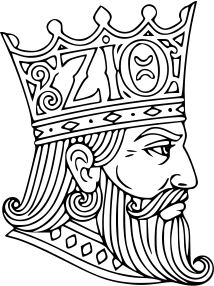
Shabnam grew up listening to her grandfather recite the Shahnameh. When she decided to design playing cards, she realized that the classic King (K), Queen (Q), and Jack (J) structure of playing cards was perfectly suited to present the power struggles and the destinies of its characters within this epic.
But she didn't simply pick a few famous heroes and depict them; instead, she carefully considered the allocation of roles for the Court Cards.
The Kingmakers (Jacks) In Persian mythology, there was a preeminent warrior family, known as the "Kingmakers," responsible for choosing new kings when the royal line lacked a suitable heir. Shabnam assigned the four Jacks to four generations of key male figures from this family.
This setup weaves a tragic tale across the cards: the Jack of Spades is the greatest hero, Rostam, while the Jack of Clubs is his son, Sohrab, born to an enemy princess. Deceived by a tyrant, Sohrab donned a mask and went to battle, fighting a duel to the death with his own father. Ultimately, Rostam, unaware, killed his own son with his own hands.
Rulers and Heroines (Kings & Queens) The four Kings represent monarchs from four distinct eras. The King of Diamonds is Fereydun, the savior wielding an ox-headed mace; the King of Clubs is Afrasyab, the tyrant of Turan, Iran's mortal enemy.
The female characters of the four Queens also each have their own stories. The Queen of Diamonds, Sindokht, used her political acumen to broker peace on the brink of war between two nations; the Queen of Hearts, Rudabeh, let down her long hair from a tall tower to invite her beloved, all for love; the Queen of Spades, Tahmineh, snuck into the hero's bedchamber to seek a child; the Queen of Clubs, Gordafarid, a Persian warrior woman, donned her armor and took to the field when the city was about to fall, outsmarting the enemy commander.
Visual Easter Eggs in the Court Cards
Winning the DOTY Best Court Cards award wasn't just about character selection. A closer look at the brushstroke details reveals Shabnam's ingenious touches.
Many cross-cultural themed decks, to highlight their uniqueness, often abandon traditional layouts, making it difficult to recognize cards during play. However, Shabnam meticulously adhered to the composition of Anglo-American standard court cards when depicting these Persian figures.
Take the King of Clubs (Afrasyab) for example. Comparing it to a standard Bicycle King of Clubs, you'll notice a similar three-quarter profile and sword-wielding posture, even retaining the iconic bifurcated mustache.
The suit symbols are also cleverly hidden within the artwork. Look closely at this tyrant; his bifurcated mustache is actually composed of club patterns. Small club symbols are also concealed within his sword hilt, shoulder armor, and the subtle patterns of his robes. The Jack of Spades (Rostam) wears a helmet made from the skull of the White Div, with Spade symbols concealed within the helmet's markings and his battle armor. The Queen of Spades (Tahmineh)'s headpiece and the edge of her veil also bear Spade outlines. This practice of embedding Easter eggs within a traditional composition adds an extra layer of enjoyment to card viewing.
Redefining the Pips
Beyond the court cards, the design of its pips is equally outstanding.
Typically, playing card pips are simply copied and pasted; for example, the 9 of Spades is just nine symbols arranged in columns. In Shahnameh, Shabnam drew inspiration from Persian mosque architecture, attire, and carpets.
She designed a geometrically symmetrical outer contour for each suit. As the card number increases from 2 to 10, the small, hollowed-out suit patterns inside the contour are progressively filled.
This evokes the image of morning sunlight passing through the dome of the Nasir al-Mulk Mosque, illuminating the stained glass patterns pane by pane. This design avoids the visual clutter often caused by full-board hand-drawn artwork while simultaneously showcasing the Persian aesthetic pursuit of intricacy and symmetry.
Perfect Imperfections
During the project's preparation phase, Shabnam posted on a forum expressing her anxiety. Seeing the increasing influx of instantaneously AI-generated ornate decks onto crowdfunding platforms, as an illustrator committed to pure hand-drawing, she felt somewhat helpless.
As a programmer who uses AI daily to assist with coding, I chatted with her for a long time in that thread. I tried to tell her that this might just be an evolution of tools, but her rebuttal made me rethink the issue.
She said: "On a digital canvas, I draw my decisions line by line; whereas AI overwrites my intentions with its algorithmic preferences." When coding, if the text is wrong, it can be modified line by line, but for an artist, if the stacking of pixels gets out of the creator's control, the sense of coherence in the creative process is broken. AI can quickly generate countless Persian-style images, but it lacks the human choices and dilemmas inherent in creation.
This is also where Shahnameh is unique. When you tilt the card face and observe the lines on the Jack of Spades' face that aren't perfectly symmetrical, you can feel the artist's repeated revisions, rather than the flawless perfection generated by an algorithm.
This "perfectly imperfect" quality imbues this deck with a unique character.
Epilogue
Turning to the back design of this deck, it also won this year's DOTY Best Back Design.
On a deep blue background, a double-headed symmetrical Persian Simurgh occupies the center. The artwork recreates the symmetrical aesthetic of Persian carpets, with precise line work. The combination of cold foil stamping and embossed texture gives the Simurgh's wings a profound visual depth under varying light, truly deserving of its 'Deck of the Year' acclaim.
On either side, outside the wings, two golden feathers are depicted.
Those are precisely the feathers the Simurgh gave to the white-haired boy, Zaul, all those years ago.
In an age where AI can rapidly generate images, Shabnam chose hand-drawing. With each stroke, she drew this feather for herself, and for the players.
I believe that when the DOTY judges and players voted for this deck, they were not only applauding the niche Persian culture but also moved by the vibrant human artistry within what can often be a cold, industrial product.