The Moon: Humanity's Universal Canvas – A Myriad of Myths in a Deck of Cards
It's Mid-Autumn Festival once again. As I gaze up at the full moon, beyond the familiar longing for distant loved ones sharing the same lunar glow, this year an additional question arose: What stories would an Italian designer, an Irish bard, or a Scottish farmer conjure in their minds when looking up at that very same moon?
The moon is the most colossal, most silent universal symbol suspended above human civilization.
It speaks no words itself, merely waxing and waning in an endless cycle. Yet, for millennia, every civilization on Earth has been compelled to project upon it their boldest imaginings, their deepest fears, and their most romantic aspirations. It is a canvas illuminating all corners of the world, upon which we each paint our own narratives.
In the East, we have depicted the serene Guanghan Palace, Chang'e's flowing robes, and the tireless pounding of the Jade Rabbit's elixir. In the West, it is associated with the howls of werewolves, witches' gatherings, and the etymology of the word 'Lunacy.' The same moon, reflected in the pupils of different cultures, casts strikingly different shadows.
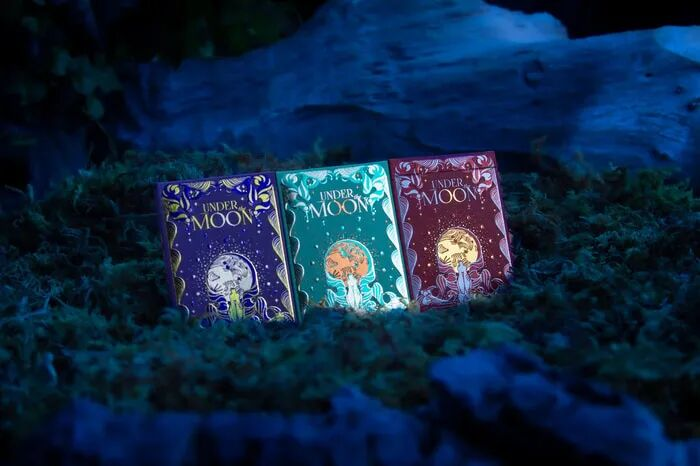
And as I opened the 'Under the Moon' deck from Italy, I found myself holding a superb physical embodiment of this 'universality' and 'individuality.' It takes the moon, a theme common to all the world, and yet within its 54 cards, it is packed with ancient and unique animal myths exclusive to the European continent. It feels like an invitation, allowing me to consider our relationship with the world from a completely new perspective.
One Moon, Two Rabbits: Different Hares Under the Same Lunar Gaze
In South Africa, there's a long-standing story that the moon sent a hare to deliver a message to humans: that after death, people would be reborn just like the moon. But this hare was lazy and careless, delivering the wrong message, ultimately angering the moon. Its lips were split open as punishment, giving rise to the cleft lip we see today. This is an origin myth with a cautionary undertone; the hare in the story is mortal, flawed in character, carrying a hint of retribution.
This creates an interesting disjuncture for me.
In our stories, the rabbit on the moon is the embodiment of purity and sacrifice. Whether it's the 'Jade Rabbit pounding elixir' or Japan's 'Moon Rabbit pounding mochi,' it selflessly dedicates itself to others. It is not a messenger, but a symbol of longevity and elixirs, Chang'e's sole companion. It is silent, diligent, imbued with a gentle, tragic poeticism.
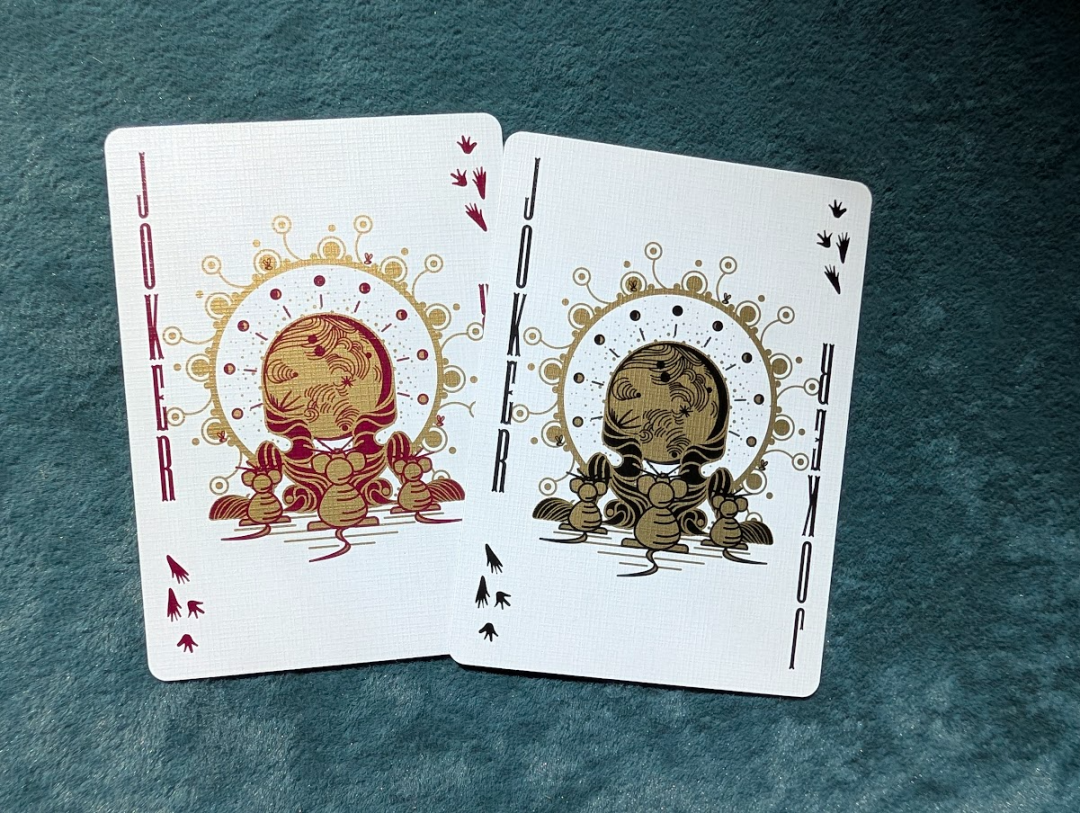
A small deck of playing cards inadvertently becomes a reference point for two cultures. We, and designer Alessandra Gagliano, may have never met, yet under the same moon, we tell vastly different stories about rabbits.
This feeling is extraordinary; it made me realize that cultures are not isolated islands. We can always find such unexpected vehicles to glimpse each other's spiritual worlds.
This rabbit sprinting across the card back was the deck's first greeting to me, an echo from beneath a foreign moon. It made me realize that to truly understand this deck, merely gazing at the 'same moon' is far from enough. We must follow its footsteps, flipping from card back to face, delving from grand cultural resonance into those more specific, more subtle mythical details.
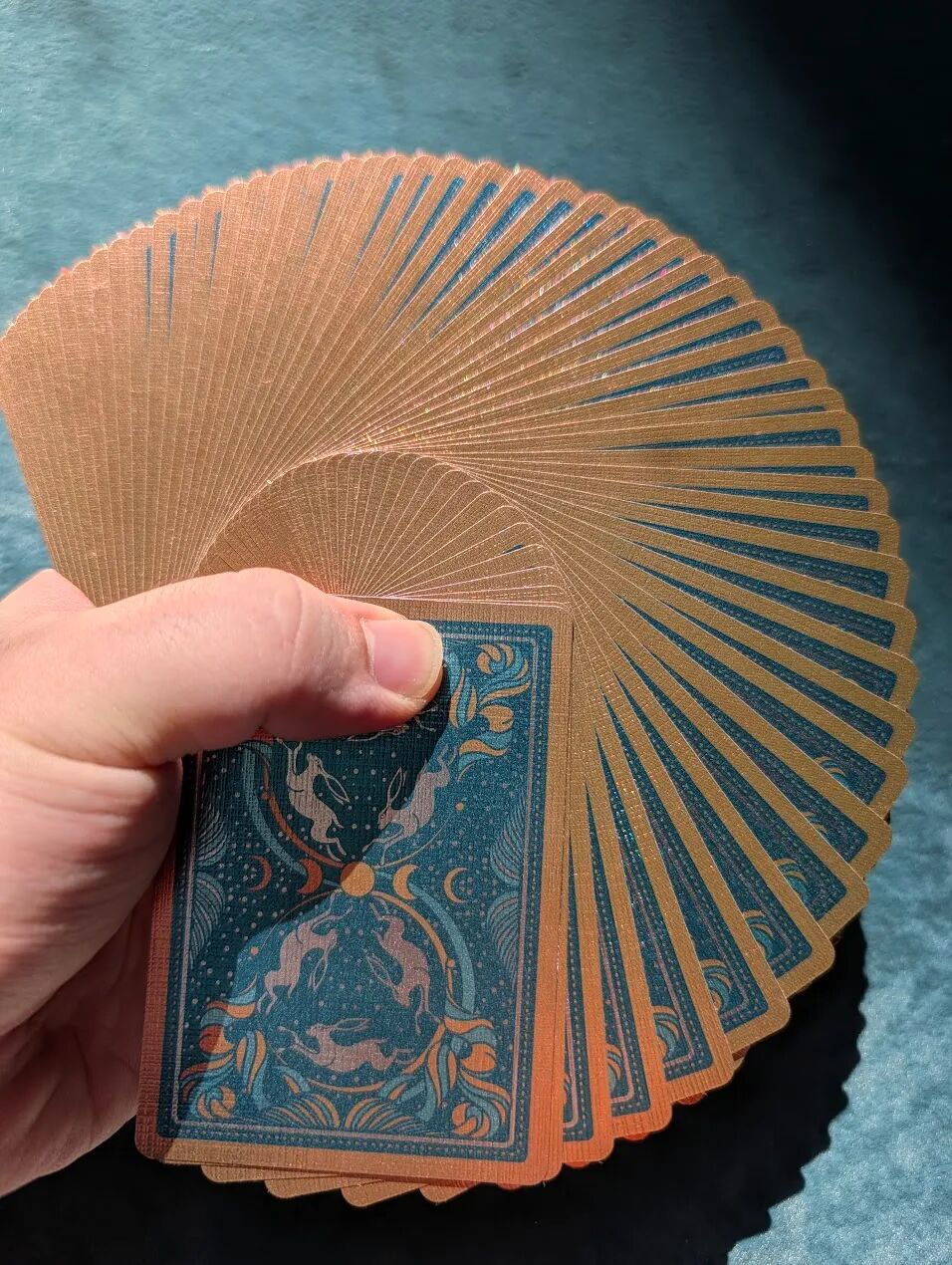
Because true stories are often not written in the sky, but hidden in forest streams and caves. Moonlight is impartial, but each land it illuminates grows distinctly different secrets.
Now, let us use this moonlight to turn over the cards and see what lies beneath the moon of that ancient continent.
A Bestiary of Animism: Animal Theater Beneath the Moonlight
'Under the Moon's' ambition extends far beyond telling a rabbit's story. It is a micro-bestiary of European animal myths, condensed within a deck.
Designer Alessandra Gagliano was not content with a single version, lavishly creating three editions, featuring 36 completely distinct court cards. Each deck is an independent animal theater.
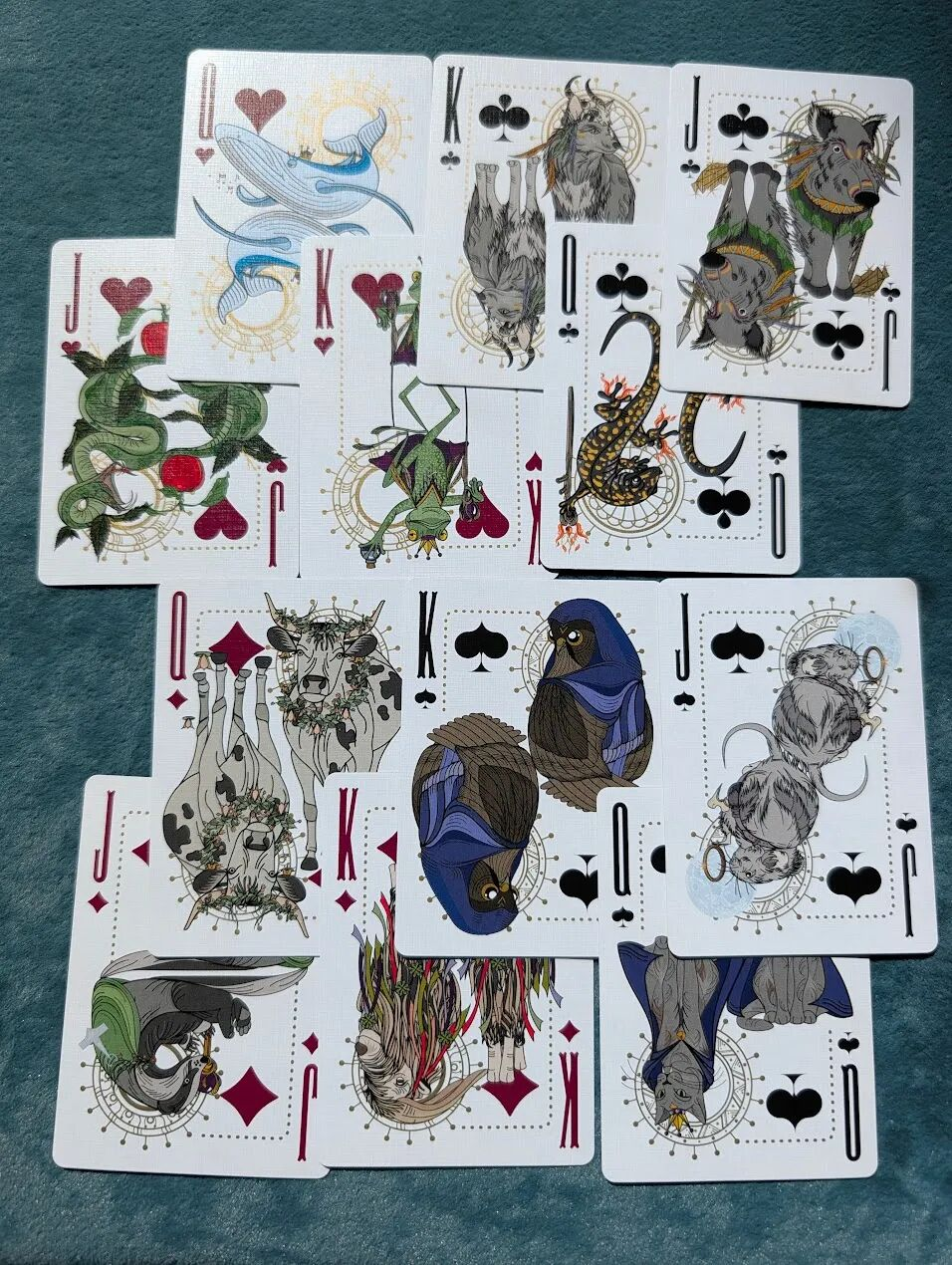
She categorized Europe's most common animals according to the ancient Four Elements, corresponding them to the four suits of playing cards:
- ♥️ Hearts (Water): Home to aquatic creatures like the Salmon of Knowledge, the Selkie, and the Otter King.
- ♠️ Spades (Air): Belonging to inhabitants of the sky and heights, such as the Prophetic Squirrel, the Wise Owl, and the Gliding Bat.
- ♣️ Clubs (Fire): Representing wild hunters and prey, like the Cunning Fox, the Brave Wild Boar, and the Mysterious Wolf.
- ♦️ Diamonds (Earth): Our neighbors of the fields, such as the Fairy Rabbit and the Apple-Stealing Hedgehog.
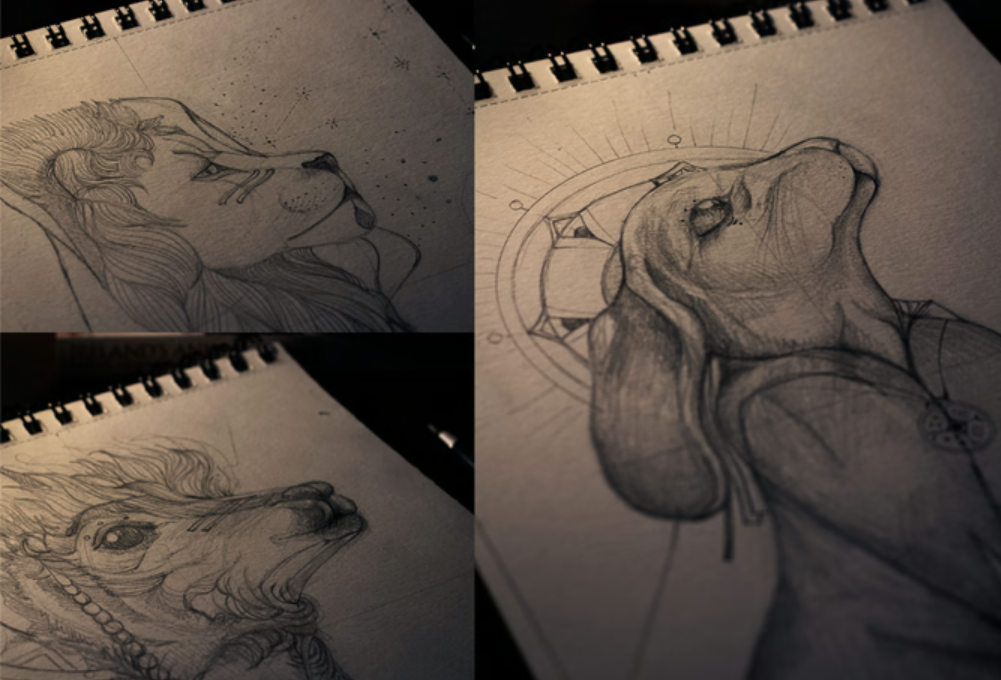
This systematic design imbues the entire deck with profound substance. Even more remarkably, the three different editions collectively contain 36 entirely unique court cards. This means the designer meticulously hand-drew 36 distinct animal mythical figures for this series, constructing a vast and captivating animal mythology. These animals are not merely anthropomorphic; their postures, attire, and props are closely linked to their identities and powers in folklore. This painstaking attention to detail elevates the design depth of the entire series far beyond typical 'animal illustration' designs.
Take, for example, the King of Hearts from the Midnight edition. The illustration depicts an otter wearing a crown and a purple robe. At first glance, it might seem like just an anthropomorphic animal monarch. But upon closer inspection, you'll notice its hands are bound by iron chains. This detail instantly injects tension into the entire scene. Why is it imprisoned? Is it a deposed monarch, or is it fulfilling some ancient covenant?
This is precisely the foreshadowing laid by the designer. In Celtic mythology, the 'Otter King' is a powerful spirit whose fur is impervious to weapons and who knows many secrets. To extract information from it, one must bind it with iron. These shackles, far from diminishing the King's majesty, instead become proof of its profound knowledge and extraordinary status. A small chain imbues this single card with a complete story background.
The Jack of Hearts from the same deck is equally intriguing. The salmon in the illustration wears spectacles, its eyes gleaming with wisdom. In Celtic mythology, particularly the Irish Fenian cycle, this is the Salmon of Knowledge, which ate the hazelnuts of wisdom; whoever consumes it gains all the world's knowledge.
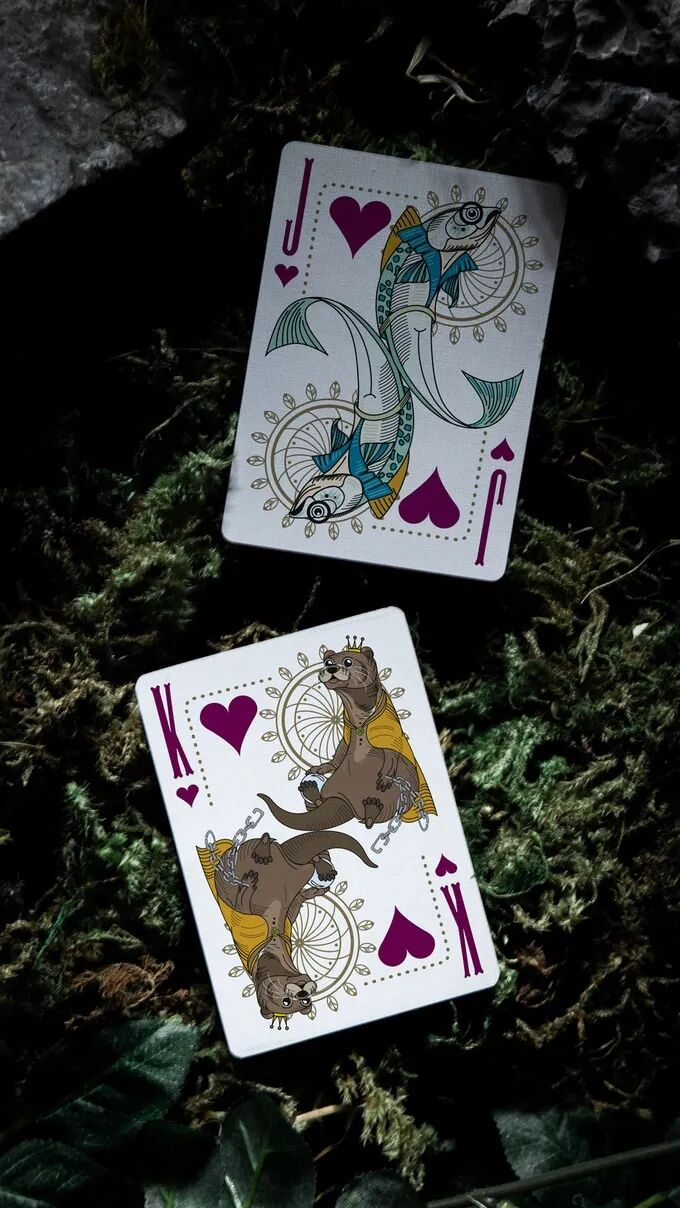
This is where 'Under the Moon' truly captivates. The designer is not 'drawing animals,' but 'telling stories.' Whether it's the wisdom-embodying Salmon or the Otter King who speaks only after being bound, each court card is a slice of a story, a microcosm of a myth.
Even the pip cards hold hidden depths. From Ace to 10, the animal footprints surrounding the pips continuously extend, as if one can hear their rustling footsteps as they run from one corner of the card to another.
Note: Scans of all three Under the Moon decks are available in the accompanying gallery.
A Moonlight Triptych: A Mythical Night's Harmony
If the internal narrative is the skeleton, then color and packaging are its flesh and blood. The most immediate impact of this series comes precisely from this.
Three versions, three moonlights, three moods:
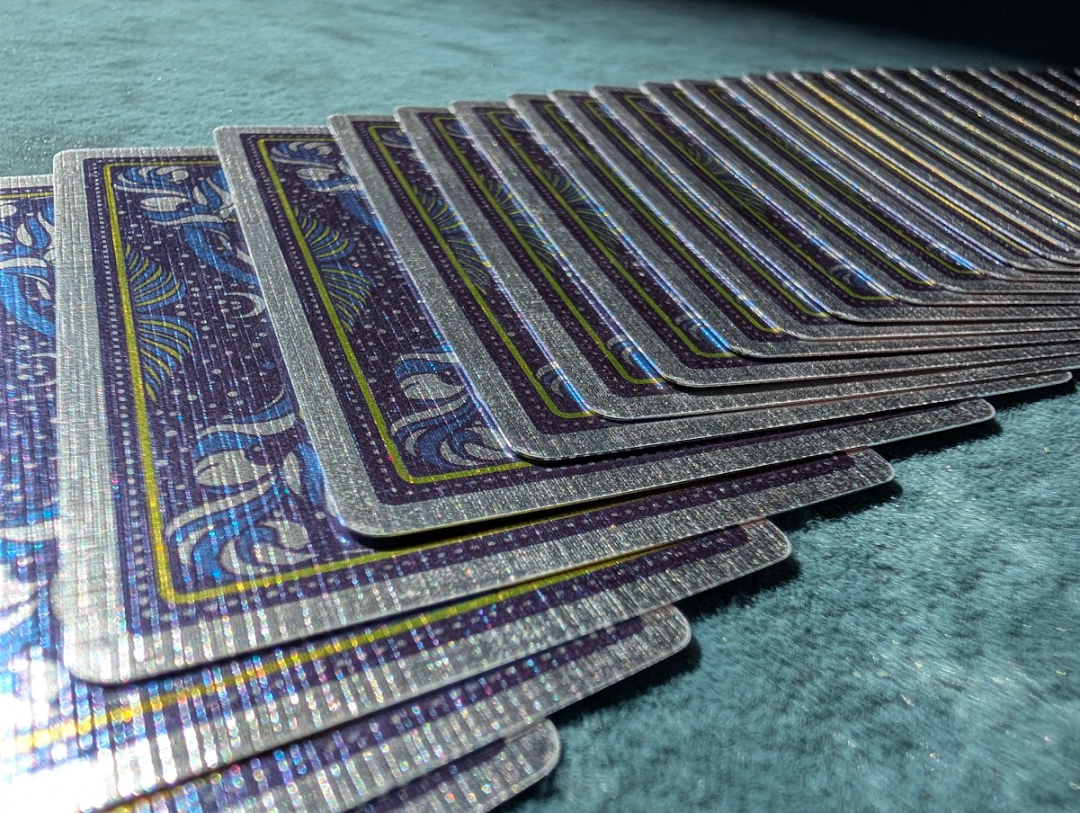
- Midnight: Deep blue tuck box and card backs, complemented by silver and gold cold foil, like moonlight and stars in a clear night sky – quiet and mysterious.
- Moorland: A combination of teal and antique bronze, carrying a hint of earthy fragrance and marshy dampness, full of natural vitality and a touch of wild danger.
- Moonrise: A warm rose pink paired with silver and gold, representing that most ambiguous, most fantastical light in the sky at dawn or dusk.
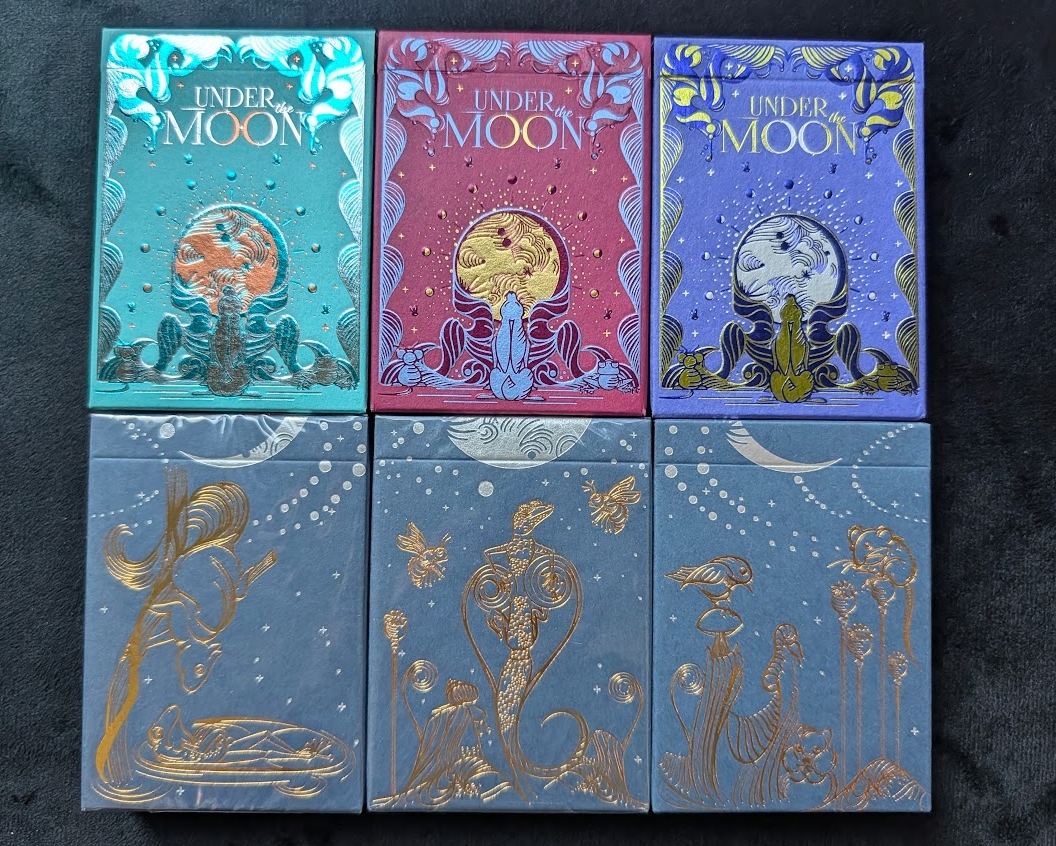
And its limited edition gilded tuck boxes take the concept of 'overall coherence' to the extreme. The three individual tuck boxes can be pieced together at the sides to form a complete 'triptych' – countless animals gathering from all directions in a deep forest, paying homage to the radiant full moon in the night sky. It ceases to be three independent decks and becomes a complete work of art.
Deck of the Year Awards: An Acclaimed Yet Uncrowned Gem
In the 2023 Deck of the Year (DOTY) awards, 'Under the Moon,' released at the beginning of the year, received eight nominations, achieving third place overall, third for best card back, and third for best court cards. This is not a bad result, but not top-tier either, suggesting that in certain aspects, it might not have entirely conquered the most discerning collectors. Perhaps Cartamundi's B9 stock felt too soft, not as crisp as USPCC's; or perhaps its design language was too 'European,' failing to evoke broader cultural resonance.
However, to stand firm in three of the most crucial categories—overall, card back, and court cards—in a highly competitive judging pool, is sufficient proof that its comprehensive quality and design ingenuity won the approval of most players. It might not be a groundbreaking masterpiece that takes the industry by storm, but rather like a skilled painter, it uses sincere, meticulous strokes to depict a world worth revisiting and savoring.
As I handle this deck, the moon outside my window has risen high without me noticing.
What can an outstanding deck of playing cards do? It begins as a beautifully designed industrial product, then, in a certain moment, it transcends itself.
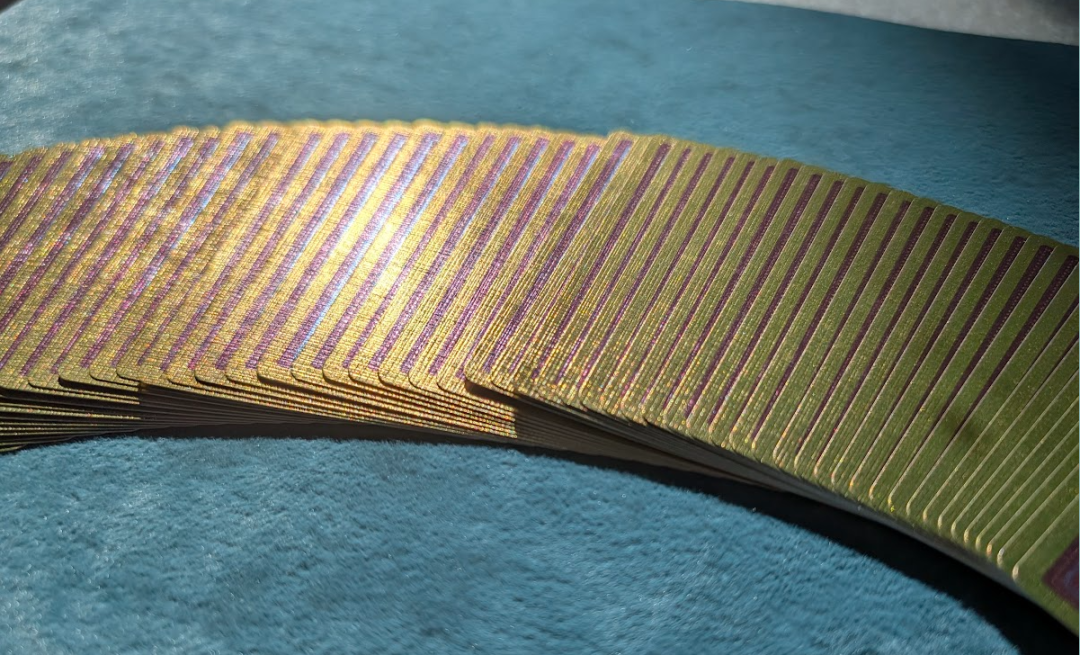
'Under the Moon' is precisely that. It is no longer merely a collection of paper, ink, and hot foil stamping. It has become a mirror, reflecting a common human trait: we are beings who crave stories; we ceaselessly strive to imbue meaning into the silent world around us. The 36 animals within the tuck box are not just 36 illustrations; they are the 36 flashes of awe, imagination, and curiosity that our ancestors harbored when gazing upon nature.
In this 'disenchanted' era, we have grown accustomed to explaining everything with science, yet we often forget that ancient myths and legends are equally indispensable foundations of our spiritual world. Opening this deck is like performing a small ritual of 're-enchantment.' It reminds us that between us and cold reality, there always exists a warm and fantastical middle ground, constructed from stories.
The Mid-Autumn full moon symbolizes 'reunion.' And this deck has facilitated an even more wondrous 'spiritual reunion.' This is perhaps its greatest value – regardless of rankings, regardless of craftsmanship, it allows the Jade Rabbit of Eastern myth to meet the European Hare of legend in my thoughts; it enables the Celtic Otter King to converse across time and space with our culture's River God. This is a reunion of human imagination, proving that no matter where we are, giving meaning to the silent world is our common nature.
I hope that not only during the Mid-Autumn Festival, but on any ordinary night, you will again be willing to look up at that bright moon.
What you see will not just be a satellite, but the echo of countless myths and stories.
Detailed scans of all three Under the Moon decks are available in the accompanying gallery.